A Theory on Why Car Insurance Premiums Are on The Rise

As many motorists will have noticed recently insurance premiums have risen astronomically and many are asking why.

I have a theory.

In 2010, while driving to the shop one wintery evening I came to a junction controlled by traffic lights, and my light was red so I obviously stopped. To my left a Morrisons truck also stopped. On getting a green light, I pulled forward a bit as I was turning right and traffic coming the other way had priority. The Morrisons truck to my left started turning left, and the trailer hit an icy patch and slid into the side of my car, destroying the nearside wing mirror and leaving scratches and scrapes on the front passenger door.

Next day I called the insurance company, gave them the details of what had happened, they advised that not only did they cover me but coincidentally they also covered the Morrisons fleet as well. That same day they had a replacement car out to me and collected my car to be repaired. The place that would be doing the repairs took it on a flatbed truck.

A couple of weeks later my car was returned to me with the repairs having been done. The replacement car was taken away and it was all done and dusted.

Cut to 13 years later and compare that experience with my latest one after a minor accident. Driving from my home in Scotland to my Mum and Stepdad’s in Wales, I stopped off at Todhills rest area on the M6 for a coffee. On leaving the area I began to accelerate down the slip road to rejoin the motorway when a truck driver in front decided to stop his truck, on the slip road, open his cab door in order to empty his coffee or tea mug outside. I’d moved over to pass him when the bottom corner of his door made contact with my car, hitting it just below roof level, denting the A pillar and the front passenger door, shattering the glass in that door, leaving paint on the B and C pillars and leaving gouges out of the rear quarter glass.

By this point I was almost back on the motorway so it wouldn’t have been safe to stop, I had to keep going. When I got to Wales I could get out and see the extent of the damage. Again I called the insurance company that same day and gave them the details. They had a hire car out to me the next day and said they’d arrange for a repairer to collect my car from my home and get it repaired.

So I waited. And then I waited some more. And more. After 4 weeks a company called Motor Repair Network, (MRN) contacted me to arrange to collect my car and said they had a repairer in Glasgow who would do the required work. This repairer was called Activate Accident Repair, (AAR) but my next call didn’t come from them. It came from yet another company called Glasgow Recovery who announced they’d actually been given the task of collecting the car and taking it to Glasgow, to the actual company who would be doing the repairs.

Once the car got to AAR they sent me a link to an online portal where they said I could keep updated on the progress of the repairs, so I watched as it went through assessment, estimated cost, approval from the insurance and then a status of repairs completed. I waited a few days after this status had appeared and then contacted what I thought was the repair company AAR, through their own portal, but it was MRN who responded stating that the repairs had been completed, but that the repairer was awaiting parts which were on back order. So, the repairs are complete, meaning finished, done, finito. But they’re waiting for parts. Parts needed to carry out the repairs. The repairs which are completed. Hmmm.

3 weeks after the status repairs completed had appeared on the portal I got a call from the actual repairers AAR asking if it would be OK to bring my car back that afternoon, which was fine by me as you can probably imagine.

From start to finish the repairs to what was really minor damage had taken almost exactly 3 monthsand involved input from the insurance, the broker or whatever they are, this Motor Repair Network, a recovery company and the actual repairers themselves Activate Accident Repair. 4 companies to do what 2 had been able to do some 13 years prior. And each one of those companies would have needed payment for their part of the job.

Coincidentally, both cars were Peugeot 3008s and both had been damaged by trucks.

Urinary catheters: what they are and how they can help

Urinary catheters are flexible tubes that are used to drain the bladder and collect urine in a drainage bag or a valve. They can be inserted through the urethra (the tube that carries urine out of the body) or through a small opening in the lower abdomen (the tummy). Urinary catheters are usually inserted by doctors or nurses in hospital or in the community.

There are different types of urinary catheters, depending on how long they are needed and how they are inserted. The main types are:

I have a Supra-Pubic Catheter. This is a tube that is inserted into a hole in my lower abdomen, just beneath my belly button, and directly into my bladder. I had the surgery for this in May 2018 after approximately 10 years of self-catheterising, which is inserting a tube into the urethra and into the bladder several times per day in order to drain the bladder. My hands got too unsteady to do this without causing significant pain and trauma. I made the decision to have surgery for an SPC and I’ve never looked back. Every 8 weeks a district nurse calls by my home to change the catheter.

Urinary catheters can have various benefits for people who have difficulty peeing naturally. They can:

However, urinary catheters can also have some risks and challenges, such as:

To reduce the risks and challenges of using urinary catheters, you should follow some general advice:

Urinary catheters are flexible tubes that are used to drain the bladder and collect urine in a drainage bag or a valve. They can be inserted through the urethra or through a small opening in the lower abdomen. There are different types of urinary catheters, depending on how long they are needed and how they are inserted. Urinary catheters can have various benefits for people who have difficulty peeing naturally, but they can also have some risks and challenges. To reduce these, you should choose the right type of catheter for your needs and preferences, keep your catheter clean and well-maintained, drink plenty of fluids, and seek support if you need it.

What is Sleep Apnoea and how does it affect people?

Sleep apnoea is a common sleep disorder that affects millions of people worldwide, and there’s evidence to suggest many more undiagnosed people. It occurs when the muscles in the throat relax and narrow during sleep, causing interruptions in breathing. These interruptions can last from a few seconds to minutes, and can happen hundreds of times a night. People with sleep apnoea may not be aware of their breathing problems, but they often snore loudly and gasp for air. They also tend to wake up feeling tired, groggy, and irritable.

Sleep apnoea can have serious consequences for your health and well-being. It can increase your risk of developing high blood pressure, heart disease, stroke, diabetes, and depression. It can also impair your concentration, memory, and decision-making skills, making you more prone to accidents and errors at work or school. Moreover, it can affect your relationships, mood, and quality of life.

The good news is that sleep apnoea can be diagnosed and treated effectively. The first step is to consult your doctor if you have any of the following symptoms:

  • Loud or frequent snoring
  • Choking or gasping sounds during sleep
  • Pauses in breathing while sleeping
  • Excessive daytime sleepiness or fatigue
  • Morning headaches or dry mouth
  • Difficulty staying awake or alert during the day
  • Trouble concentrating or remembering things
  • Mood swings or irritability
  • Loss of interest in sex

Your doctor may refer you to a sleep specialist who can perform a sleep study to confirm the diagnosis of sleep apnoea. A sleep study involves monitoring your breathing, heart rate, oxygen level, and brain activity while you sleep. You may be asked to wear a device at home or stay overnight at a sleep clinic.

Children can have sleep apnoea too. In fact, sleep apnoea is quite common in children, especially those who have enlarged tonsils or adenoids, which can block the airway during sleep. Other factors that can increase the risk of sleep apnoea in children are obesity, allergies, hay fever, and certain genetic conditions. Sleep apnoea can affect the quality of sleep and the development of children, so it is important to seek medical help if you notice any signs or symptoms of sleep apnoea in your child.

The most common treatment for sleep apnoea is continuous positive airway pressure (CPAP) therapy. This involves wearing a mask over your nose, mouth or both, that delivers pressurized air into your airway, keeping it open and preventing it from collapsing. CPAP therapy can improve your breathing, reduce your snoring, and enhance your sleep quality and daytime alertness.

Other treatments for sleep apnoea may include:

  • Oral appliances: These are devices that fit inside your mouth and help to keep your lower jaw forward and your tongue from blocking your airway.
  • Surgery: This may be an option for some people who have severe or persistent sleep apnoea that does not respond to other treatments. Surgery may involve removing excess tissue from the throat, nose, or mouth, or correcting structural problems that cause obstruction.
  • Lifestyle changes: These can help to prevent or reduce the severity of sleep apnoea. They include losing weight if you are overweight or obese, quitting smoking if you smoke, avoiding alcohol or sedatives before bedtime, sleeping on your side instead of your back, and keeping a regular sleep schedule.

In my case I use an APAP machine (similar to a CPAP but it automatically adjusts the air pressure depending on need) as I also have central apnoeas.  Central apnoeas are pauses in breathing that occur during sleep because the brain does not send the proper signals to the muscles that control breathing. They are different from obstructive apnoeas, which are caused by a blockage in the airway. Central apnoeas can have various causes, such as heart failure, stroke, brain injury, or high altitude. They can also cause symptoms such as snoring, daytime sleepiness, headaches, and mood changes. Central apnoeas can be diagnosed by a sleep study

If you think you or a family member may have sleep apnoea, do not ignore it. Seek medical help as soon as possible and follow the treatment plan recommended by your doctor. By doing so, you can improve your health, well-being, and quality of life.

How to Travel the World with a Wheelchair

Travelling the world is a dream for many people, but it can seem daunting or impossible if you use a wheelchair. However, with some planning, research and creativity, you can overcome the barriers and enjoy the wonders of different cultures, landscapes and experiences. In this blog post, I will share some tips and resources to help you plan your wheelchair accessible trip. I’m Dan McIntyre and I’ve travelled the length and breadth of Europe with my wheelchair, from a gondola in Venice to the Nurburgring in Germany and even stopped by the Police in Monaco.

Choose your destination wisely

Not all destinations are equally wheelchair friendly, so you need to do some research before you book your flight. Some factors to consider are:

  • The accessibility of public transportation, such as buses, trains, taxis and subways.
  • The availability of wheelchair accessible accommodation, such as hotels, hostels, apartments or homestays.
  • The accessibility of attractions, such as museums, monuments, parks, beaches and historical sites.
  • The accessibility of restaurants, cafes, bars and shops.
  • The attitude and awareness of the local people towards disability and accessibility.

You can find useful information about the accessibility of various destinations on websites such as Wheelchair TravelSimply Emma and World on Wheels. These are wheelchair travel blogs that provide comprehensive reviews and advice on accessible travel for both people with limited mobility and wheelchair users. You can also join online communities and forums where you can ask questions and get recommendations from other wheelchair travellers.

Plan your itinerary carefully

Once you have chosen your destination, you need to plan your itinerary carefully. You want to make sure that you have enough time and energy to enjoy your trip without exhausting yourself or encountering unexpected obstacles. Some tips to plan your itinerary are:

  • Book your flights well in advance and inform the airline about your wheelchair and any special assistance you may need. You can also request a bulkhead seat or an aisle seat for more space and comfort.
  • Book your accommodation in advance and confirm that it is wheelchair accessible. You can also ask for specific details such as the width of the doorways, the height of the bed, the availability of a roll-in shower or a ceiling hoist.
  • Check the opening hours and accessibility of the attractions you want to visit. You can also look for discounts or free admission for disabled visitors and their companions.
  • Plan your transportation options between different locations. You can use public transportation if it is accessible or book a wheelchair accessible taxi or rental car. You can also use apps such as Wheelmap or Access Earth to find accessible places nearby.
  • Pack light and smart. You don’t want to carry too much luggage that can weigh you down or take up space. You also want to pack essential items such as medications, spare parts, tools, chargers, adapters and travel insurance documents.

Be flexible and adventurous

Even with careful planning, you may encounter some challenges or surprises along the way. You may find that some places are not as accessible as they claimed to be or that some services are not available or reliable. You may also face some cultural differences or language barriers that can make communication difficult. However, don’t let these things ruin your trip. Instead, be flexible and adventurous and try to find alternative solutions or opportunities. Some tips to be flexible and adventurous are:

  • Be prepared for the unexpected and have a backup plan in case something goes wrong. You can also have an emergency contact number or a travel agent who can help you in case of trouble.
  • Be open-minded and respectful of the local culture and customs. You may encounter some different views or attitudes towards disability and accessibility that may not match your expectations or preferences. Try to understand their perspective and educate them if necessary.
  • Be friendly and sociable with the local people and other travellers. You may find some helpful allies or new friends who can assist you or enrich your experience. You may also learn some useful tips or insights from them.
  • Be adventurous and try new things that are within your comfort zone and abilities. You may discover some hidden gems or amazing experiences that you would not have otherwise.

Fun facts: The Police stop in Monaco was because I was following the F1 track round at some early hour of the morning and coming off a roundabout the exit I needed was being guarded by a Policeman, so in a slight panic I went completely around the roundabout and started heading back the way I’d come, not noticing the no entry signs. I’d got about 50 yards when I realised it was a one-way street and at the same time I realised that 2 Police cars stuck their lights and sirens on and parked right up to me to ask what I was doing.

The gondola ride in Venice was very expensive but also amazing. There is a jetty with a lift that can take you and your wheelchair down into the boat, so wheelchair users don’t have to leave their chair at all.

Travelling with a wheelchair may seem challenging, but it is not impossible. With some planning, research and creativity, you can explore the world and have a memorable trip. I hope this blog post has inspired you to travel more and make new discoveries, whether that’s abroad or in your own hometown. Happy travels!

Right On Track – A Day With ST Accessible Motorsport

Image

On a dark, cold and thoroughly miserable looking November morning I drag myself from my bed to the shower at 4am.  Having freshened up and gotten dressed I have a coffee and some porridge.  Then a coffee.  Then I fill my travel mug with coffee for the road.  Coffee is good.

Loaded up, I hit the road.  One good thing about travelling at this time of morning – the roads are practically empty.  Soon I’m on the M1 southbound with the music up loud, the car smelling of coffee and me feeling a lot less bleary.

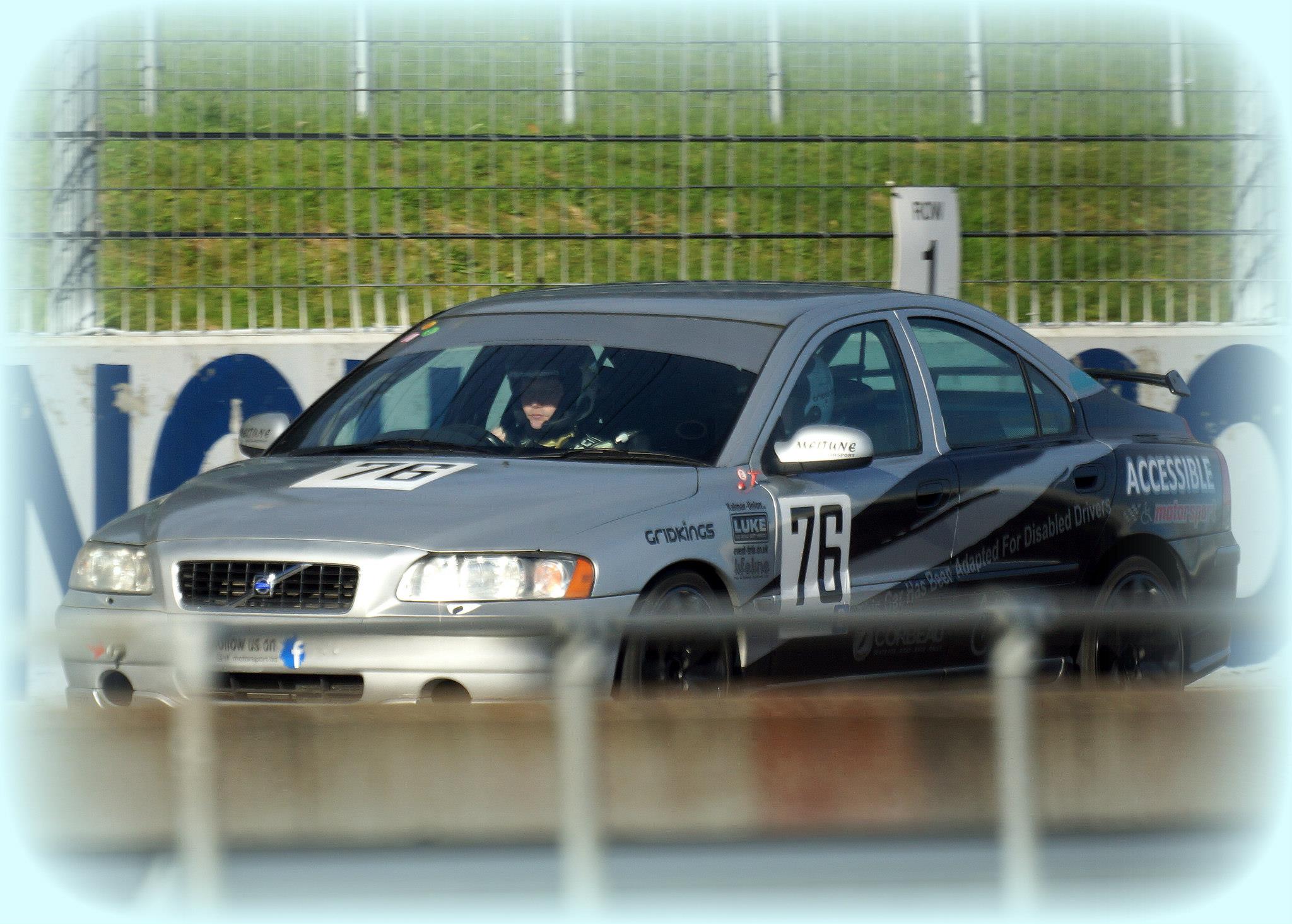
At 7:15 I arrive at Rockingham Raceway and, following directions from the security guard, wind my way around the roads within the complex to the paddock where I find the ST Motorsport van and trailer.  The Volvo S60 T5 is being unloaded and taken into the garage.  I park up and make my way into the garage where Steve Collett welcomes me.  Then it hits me that today I am actually going to drive the beast I’ve just seen being unloaded.  I have seen this car several times at shows and events such as Get Going and Motability One Big Days and have wanted to get behind the wheel for several months.  This car is race prepared and adapted with hand controls and the controls can be adapted very quickly to suit drivers with various disabilities.

There’s another chap in the garage named Steve – Steve Tarrant.  He has a motorhome and has stayed overnight at the complex.  He shakes my hand and introduces himself and we have a chat.  Steve is an experienced motorsport marshall, talking to him it is clear that racing is in his blood and his passion for it is such that after losing a leg when an F1 car tore it off at 180mph he fought the authorities to be allowed to continue marshalling and was the first marshall who uses a wheelchair.

Did I mention that I’ve wanted for a while to get behind the wheel of this Volvo?  Before I can take the controls myself I have to be driven round as a passenger for sighting laps and this is the part that has worried me – I am a very nervous passenger having been driving more than half my lifetime and the thought of getting into the passenger seat of a race car while being driven around “Europe’s fastest track” by a racing driver has filled me with dread.  I even ask if it’s necessary and am told it is.

So I transfer into the passenger seat, over the carbon covered spar of the roll cage, and am strapped in nice and tight.  This should be reassuring as it is obvious I’m not going anywhere but it feels claustrophobic.  Our driver for today is Paul Rivett, a driver in the Clio Cup who is currently close to the top of the leaderboard.  This is a little reassuring but I am still nervous.  As he gets in and straps himself in I explain to him how I feel and ask, pathetically, if he can “take it steady” once out on the track.  I am surprised when he agrees and explains that today is a track day, that we’re not going to be racing and can go as fast as I feel comfortable with.  This is a great comfort to me and I relax a fair bit.

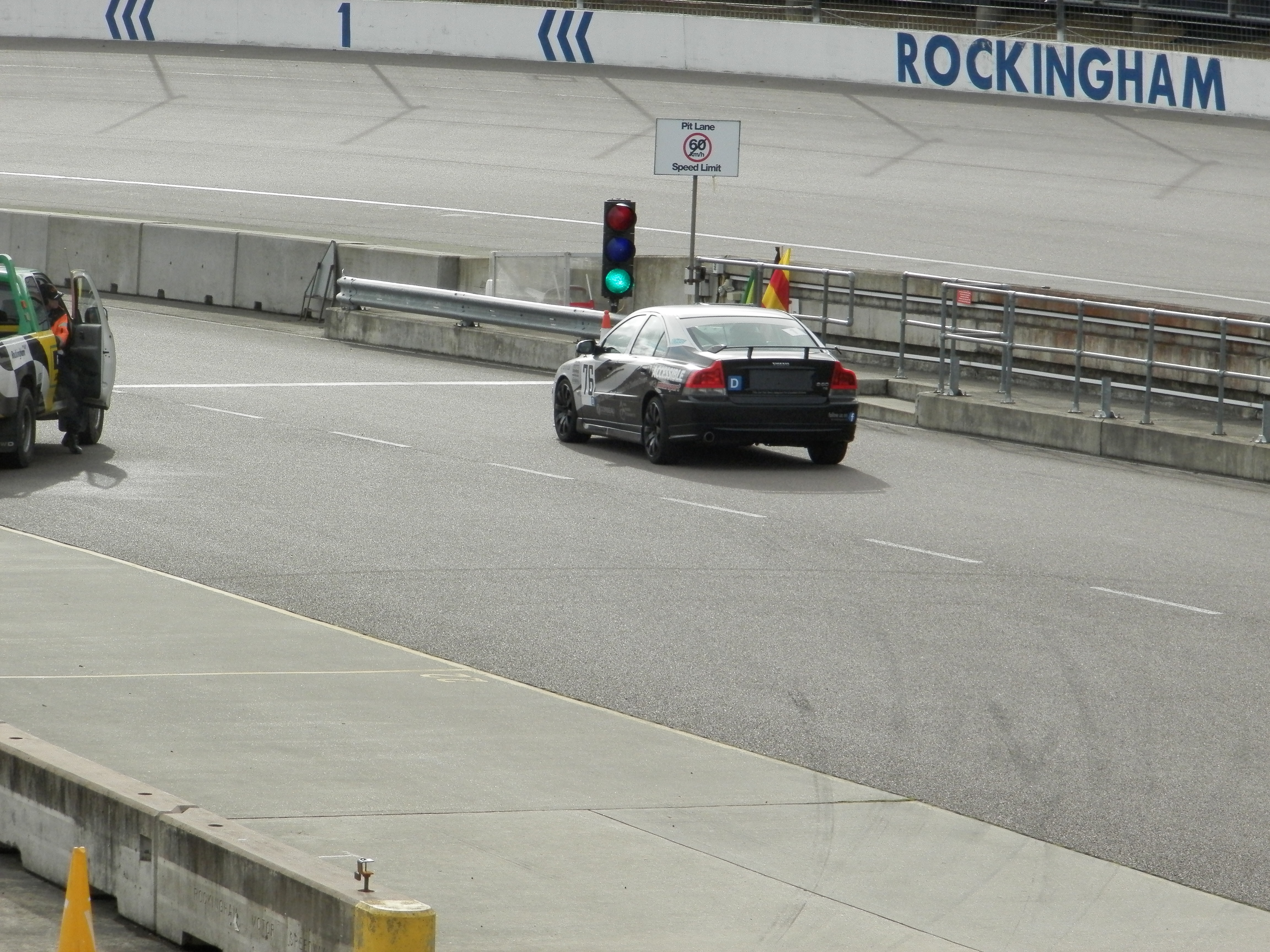
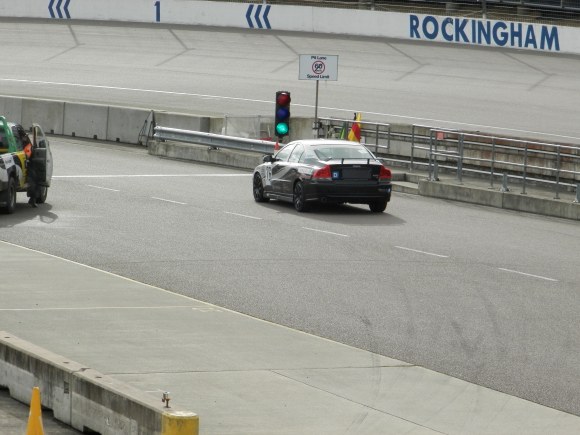
Guided out by Steve Collett we leave the garage and enter the pit lane, checking it’s clear before moving out towards the traffic lights and the track.  Approaching the lights the marshall there holds his arm up and points to his wrist.  We raise our arms and show our wristbands, signifying that we are registered as drivers and have attended the drivers briefing.  Satisfied, the marshall waves us past and we accelerate as the pit lane ends and we join the track proper.  The sun has made an appearance and most of the track is bright and dry, with just a couple of damp patches.
Image

The pit lane joins the track right after turn one, one of the fastest points on the track, and straight away there are cars whizzing past on our right.  This is the only part of the track where overtaking is permitted on the right.  At all other times the rules say to pass on the left and there is no overtaking on bends, only on straights.

Paul’s voice comes in over the intercom as he asks how I am.  I say something in reply, I can’t remember what, and Paul then starts giving a commentary and telling me what to look out for, where to brake, where to turn and where and when to pull the throttle wide open.  Taking a hairpin and finding a patch of water halfway round the car slides a bit and Paul corrects and holds it then tells me to look out for that.  I make a mental note and continue listening.

In what seems like no time my 3 sighting laps are done and my head is spinning trying to remember turns, braking points, turning and acceleration points.  My most dreaded part of the day has been a huge amount of fun and I am disappointed to arrive back at the garage and have to get out.  This is where I had a surprise as I had thought that Paul would take each of the 5 drivers out on their sighting laps and then we would get our turns.  This turns out not to be the case as I am bundled straight round to the driver’s side and strapped in again.  This time I will be in control and again I am slightly nervous, but an excited kind of nervous.
Image

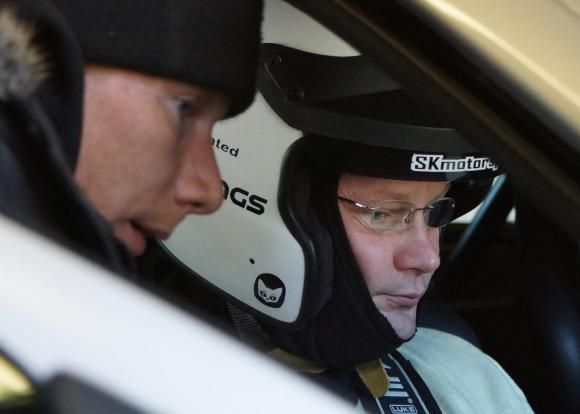
Once in and helmeted up again and Paul is ready we are again guided out of the garage and I listen intently as Paul give me guidance over the intercom, I check the pit lane carefully.  I am very aware that I am in control of a machine I have never driven before and which someone else has put a lot of time, effort and money into and am entering an area filled with more of the same, including some very exotic machines.  I don’t want to be the one responsible for damaging any of it.

Approaching the marshall near the end of the pit lane we again raise our arms and get the wave.  Paul tells me to go for it and I accelerate out of the pit lane, a check in the mirror and over my shoulder for traffic and I am on the track.  On.  The.  Track.  For the first time.  First impressions – I am impressed by how light the throttle is and how the car responds.  I am also very aware of the other traffic around me.

Lap 1 and Paul is reminding me of the braking and turning points.  I had noticed on the sighting laps how he used the whole width of the track when taking the bends and I start to do the same.  Coming to the hairpin where we slid previously I take it perhaps a touch too fast and the car starts sliding a fair bit.  I steer into it and ease off the gas and once the car has settled down I pull the throttle again and receive a congratulations from Paul for the way I’d held and corrected the slide.  While I hear that I am thinking it was my fault we slid in the first place but there’s no time to dwell on that for we are fast approaching a turn which sits at the crest of a short hill and appears to me to be a left hander but is in fact a right.  I’ve approached ready to turn left and the surprise throws me somewhat.  I make it round and we then enter a series of left handers which Paul wants me to take in one long, smooth movement.  I fail miserably and the car lurches from one to the next.  Straight after this I enter the chicane a little too fast but Paul doesn’t seem to mind.  This then takes me back to the longest and fastest straight.  Paul tells me to open the throttle fully and I pull it a bit more and aim out towards the wall on the far right of the track, then hold position around six feet away for the length of the straight before easing off and moving left slightly for the banked left hand curve which is still mostly in shade and so may be slippery.  At the far side of the banked curve is that hairpin again.  I brake harder than I had on the last lap and make it round without sliding and to a comment of good from Paul.

Several laps in and I’m starting to get a feel for the track.  I now know what I can safely take the hairpins at and that the turn that appears to be a left hander is actually a right hander.  But those left turns, that everyone else seems to be able to take fluidly, still elude me.  I lurch from one to the next, missing the apex of each and getting in the way of everyone else as I repeatedly brake and then accelerate again.  Paul takes matters into his own hands, quite literally.  He tells me that on the next lap he will control the steering and show me how it’s done, and that’s exactly what he does.  Suddenly it all seems much easier and on the next lap I manage to make them all flow into one, long, smooth left hand turn.  I feel like a driving God.  This feeling is short lived as we again approach the long, fast straight and, again, Paul tells me to open the throttle.  Being quite a few laps in by now I am feeling much more confident and have a feel for the car so I open the throttle all the way, the first time I have done this.  I squeal like a little girl as the car snarls, crouches and then launches itself down the straight which suddenly doesn’t seem as long as it had before.  Driving God indeed, Paul is laughing and I can’t stop giggling at the acceleration.

A few more laps and my time is up.  I enter the pit lane on my last lap and slowly pull down past the other garages before pulling into ours.  I switch off the engine and remove my helmet.  Let out a breath and realise I’m still grinning like a Cheshire cat.  Steve is by the door with my chair and as I transfer back out the other guys ask how it was.  Only word that I can think of to do it justice – awesome.

I’ll definitely be booking a slot on another of these days and may be taking along my partner too as I think she would enjoy this experience.

I would like to thank Steve Collett, Paul Rivett and Steve Tarrant for making this possible and for their work and dedication to making motorsport accessible to disabled people.  I wish them every success in the future.

Check Your License – Is It Valid?

In January this year I placed an order for my next
Motability car with my local Peugeot dealer.
A few days after this I received a phone call from the dealer explaining
that the order had been refused by Motability because my license was
invalid.  This was a shock to me as,
having renewed my license in 2009, I had noted that it was valid until 2047.

A quick phone call to the DVLA in Swansea revealed the
problem – driving license holders are now required to update the photos on
their license every 10 years.  The expiry
date of the photo is shown in section 4b on the photocard part of your license.

In order to update the photo a driving license holder needs
to obtain a passport style photo, a D1 driving license application form (which
can be obtained from your local Post Office) and a cheque or postal order for
£20 made payable to DVLA Swansea.  Fill
in the relevant sections on the D1 form (it comes with a guidance leaflet) and
send the form, photo, cheque or postal order and both parts of your current
license to DVLA, Swansea, SA99 1DH.  It
is important to use the right postcode due to the way the mail is sorted at
DVLA.

In my case I sent off my application and new photo and have
now received my updated license.  And my
Peugeot dealer managed to get the car ordered with Motability.

DVLA say that they send reminders to anyone whose current
photo or license is about to expire, but this didn’t happen in my case.  With the onus being on the license holder and
with a £1000 fine if you do not update the photo, it could be worth checking.