A Theory on Why Car Insurance Premiums Are on The Rise

As many motorists will have noticed recently insurance premiums have risen astronomically and many are asking why.

I have a theory.

In 2010, while driving to the shop one wintery evening I came to a junction controlled by traffic lights, and my light was red so I obviously stopped. To my left a Morrisons truck also stopped. On getting a green light, I pulled forward a bit as I was turning right and traffic coming the other way had priority. The Morrisons truck to my left started turning left, and the trailer hit an icy patch and slid into the side of my car, destroying the nearside wing mirror and leaving scratches and scrapes on the front passenger door.

Next day I called the insurance company, gave them the details of what had happened, they advised that not only did they cover me but coincidentally they also covered the Morrisons fleet as well. That same day they had a replacement car out to me and collected my car to be repaired. The place that would be doing the repairs took it on a flatbed truck.

A couple of weeks later my car was returned to me with the repairs having been done. The replacement car was taken away and it was all done and dusted.

Cut to 13 years later and compare that experience with my latest one after a minor accident. Driving from my home in Scotland to my Mum and Stepdad’s in Wales, I stopped off at Todhills rest area on the M6 for a coffee. On leaving the area I began to accelerate down the slip road to rejoin the motorway when a truck driver in front decided to stop his truck, on the slip road, open his cab door in order to empty his coffee or tea mug outside. I’d moved over to pass him when the bottom corner of his door made contact with my car, hitting it just below roof level, denting the A pillar and the front passenger door, shattering the glass in that door, leaving paint on the B and C pillars and leaving gouges out of the rear quarter glass.

By this point I was almost back on the motorway so it wouldn’t have been safe to stop, I had to keep going. When I got to Wales I could get out and see the extent of the damage. Again I called the insurance company that same day and gave them the details. They had a hire car out to me the next day and said they’d arrange for a repairer to collect my car from my home and get it repaired.

So I waited. And then I waited some more. And more. After 4 weeks a company called Motor Repair Network, (MRN) contacted me to arrange to collect my car and said they had a repairer in Glasgow who would do the required work. This repairer was called Activate Accident Repair, (AAR) but my next call didn’t come from them. It came from yet another company called Glasgow Recovery who announced they’d actually been given the task of collecting the car and taking it to Glasgow, to the actual company who would be doing the repairs.

Once the car got to AAR they sent me a link to an online portal where they said I could keep updated on the progress of the repairs, so I watched as it went through assessment, estimated cost, approval from the insurance and then a status of repairs completed. I waited a few days after this status had appeared and then contacted what I thought was the repair company AAR, through their own portal, but it was MRN who responded stating that the repairs had been completed, but that the repairer was awaiting parts which were on back order. So, the repairs are complete, meaning finished, done, finito. But they’re waiting for parts. Parts needed to carry out the repairs. The repairs which are completed. Hmmm.

3 weeks after the status repairs completed had appeared on the portal I got a call from the actual repairers AAR asking if it would be OK to bring my car back that afternoon, which was fine by me as you can probably imagine.

From start to finish the repairs to what was really minor damage had taken almost exactly 3 monthsand involved input from the insurance, the broker or whatever they are, this Motor Repair Network, a recovery company and the actual repairers themselves Activate Accident Repair. 4 companies to do what 2 had been able to do some 13 years prior. And each one of those companies would have needed payment for their part of the job.

Coincidentally, both cars were Peugeot 3008s and both had been damaged by trucks.

Space Invaders

This post, from the blog diary of a disabled person, explains what happens when people use spaces designed for disabled people.

Urinary catheters: what they are and how they can help

Urinary catheters are flexible tubes that are used to drain the bladder and collect urine in a drainage bag or a valve. They can be inserted through the urethra (the tube that carries urine out of the body) or through a small opening in the lower abdomen (the tummy). Urinary catheters are usually inserted by doctors or nurses in hospital or in the community.

There are different types of urinary catheters, depending on how long they are needed and how they are inserted. The main types are:

I have a Supra-Pubic Catheter. This is a tube that is inserted into a hole in my lower abdomen, just beneath my belly button, and directly into my bladder. I had the surgery for this in May 2018 after approximately 10 years of self-catheterising, which is inserting a tube into the urethra and into the bladder several times per day in order to drain the bladder. My hands got too unsteady to do this without causing significant pain and trauma. I made the decision to have surgery for an SPC and I’ve never looked back. Every 8 weeks a district nurse calls by my home to change the catheter.

Urinary catheters can have various benefits for people who have difficulty peeing naturally. They can:

However, urinary catheters can also have some risks and challenges, such as:

To reduce the risks and challenges of using urinary catheters, you should follow some general advice:

Urinary catheters are flexible tubes that are used to drain the bladder and collect urine in a drainage bag or a valve. They can be inserted through the urethra or through a small opening in the lower abdomen. There are different types of urinary catheters, depending on how long they are needed and how they are inserted. Urinary catheters can have various benefits for people who have difficulty peeing naturally, but they can also have some risks and challenges. To reduce these, you should choose the right type of catheter for your needs and preferences, keep your catheter clean and well-maintained, drink plenty of fluids, and seek support if you need it.

How to Travel the World with a Wheelchair

Travelling the world is a dream for many people, but it can seem daunting or impossible if you use a wheelchair. However, with some planning, research and creativity, you can overcome the barriers and enjoy the wonders of different cultures, landscapes and experiences. In this blog post, I will share some tips and resources to help you plan your wheelchair accessible trip. I’m Dan McIntyre and I’ve travelled the length and breadth of Europe with my wheelchair, from a gondola in Venice to the Nurburgring in Germany and even stopped by the Police in Monaco.

Choose your destination wisely

Not all destinations are equally wheelchair friendly, so you need to do some research before you book your flight. Some factors to consider are:

  • The accessibility of public transportation, such as buses, trains, taxis and subways.
  • The availability of wheelchair accessible accommodation, such as hotels, hostels, apartments or homestays.
  • The accessibility of attractions, such as museums, monuments, parks, beaches and historical sites.
  • The accessibility of restaurants, cafes, bars and shops.
  • The attitude and awareness of the local people towards disability and accessibility.

You can find useful information about the accessibility of various destinations on websites such as Wheelchair TravelSimply Emma and World on Wheels. These are wheelchair travel blogs that provide comprehensive reviews and advice on accessible travel for both people with limited mobility and wheelchair users. You can also join online communities and forums where you can ask questions and get recommendations from other wheelchair travellers.

Plan your itinerary carefully

Once you have chosen your destination, you need to plan your itinerary carefully. You want to make sure that you have enough time and energy to enjoy your trip without exhausting yourself or encountering unexpected obstacles. Some tips to plan your itinerary are:

  • Book your flights well in advance and inform the airline about your wheelchair and any special assistance you may need. You can also request a bulkhead seat or an aisle seat for more space and comfort.
  • Book your accommodation in advance and confirm that it is wheelchair accessible. You can also ask for specific details such as the width of the doorways, the height of the bed, the availability of a roll-in shower or a ceiling hoist.
  • Check the opening hours and accessibility of the attractions you want to visit. You can also look for discounts or free admission for disabled visitors and their companions.
  • Plan your transportation options between different locations. You can use public transportation if it is accessible or book a wheelchair accessible taxi or rental car. You can also use apps such as Wheelmap or Access Earth to find accessible places nearby.
  • Pack light and smart. You don’t want to carry too much luggage that can weigh you down or take up space. You also want to pack essential items such as medications, spare parts, tools, chargers, adapters and travel insurance documents.

Be flexible and adventurous

Even with careful planning, you may encounter some challenges or surprises along the way. You may find that some places are not as accessible as they claimed to be or that some services are not available or reliable. You may also face some cultural differences or language barriers that can make communication difficult. However, don’t let these things ruin your trip. Instead, be flexible and adventurous and try to find alternative solutions or opportunities. Some tips to be flexible and adventurous are:

  • Be prepared for the unexpected and have a backup plan in case something goes wrong. You can also have an emergency contact number or a travel agent who can help you in case of trouble.
  • Be open-minded and respectful of the local culture and customs. You may encounter some different views or attitudes towards disability and accessibility that may not match your expectations or preferences. Try to understand their perspective and educate them if necessary.
  • Be friendly and sociable with the local people and other travellers. You may find some helpful allies or new friends who can assist you or enrich your experience. You may also learn some useful tips or insights from them.
  • Be adventurous and try new things that are within your comfort zone and abilities. You may discover some hidden gems or amazing experiences that you would not have otherwise.

Fun facts: The Police stop in Monaco was because I was following the F1 track round at some early hour of the morning and coming off a roundabout the exit I needed was being guarded by a Policeman, so in a slight panic I went completely around the roundabout and started heading back the way I’d come, not noticing the no entry signs. I’d got about 50 yards when I realised it was a one-way street and at the same time I realised that 2 Police cars stuck their lights and sirens on and parked right up to me to ask what I was doing.

The gondola ride in Venice was very expensive but also amazing. There is a jetty with a lift that can take you and your wheelchair down into the boat, so wheelchair users don’t have to leave their chair at all.

Travelling with a wheelchair may seem challenging, but it is not impossible. With some planning, research and creativity, you can explore the world and have a memorable trip. I hope this blog post has inspired you to travel more and make new discoveries, whether that’s abroad or in your own hometown. Happy travels!

A Day on the Waverley: The World’s Last Seagoing Paddle Steamer

Have you ever wondered what it would be like to travel on a steam-powered ship, with the sound of the paddles splashing in the water and the smell of coal and oil in the air? If so, you might want to book a ticket on the Waverley, the world’s last seagoing paddle steamer.

The Waverley is a historic vessel that was built in 1946 and named after Sir Walter Scott’s first novelShe was originally designed to sail from Craigendoran on the Firth of Clyde to Arrochar on Loch Long in Scotland, carrying passengers and cargoShe was operated by the London and North Eastern Railway until 1948, when she became part of the Caledonian Steam Packet Company, a subsidiary of the nationalised British RailwaysShe wore different funnel colours and logos over the years, reflecting the changes in ownership and branding.

The Waverley continued to serve the Scottish coast until 1973, when she was withdrawn from service due to rising costs and declining demandShe was saved from being scrapped by the Paddle Steamer Preservation Society (PSPS), a charity that was formed in 1959 to preserve and operate historic paddle steamersThe PSPS restored the Waverley to her original 1947 appearance and began to operate her as a tourist attraction, offering passenger excursions around the British coast.

Today, the Waverley is a unique and popular attraction that attracts thousands of visitors every year. She sails from various ports and piers, such as London, Glasgow, Southampton, Bristol, Liverpool, Llandudno and many more. She offers a variety of cruises, ranging from short trips to full-day excursions, along scenic routes that showcase the beauty and history of the British coastline. Some of her destinations include the Isle of Wight, the Jurassic Coast, the Scottish islands, the Thames Estuary and more.

My day on board the Waverley started early one summer morning on the dock in Glasgow, where she sat there resplendent with her red funnels glinting in the sunlight. First order of the day was to get a sausage sandwich and a coffee from the galley. That done we went into the aft lounge to eat breakfast. Then we were off.

What surprised me most about the Waverley was the power produced by the engine and transmitted to the large paddle wheels on either side of her. Within a few minutes we were making good progress to the sea.

Once we reached the sea the Waverley really showed her great strength, increasing her speed and remaining totally stable.

One interesting and quirky feature of the boat is a Royal Mail post box, where postcards can be sent from!

The Waverley is not only a sightseeing vessel, but also a living museum that preserves and showcases the heritage of steam navigation. She is powered by a diagonal triple expansion steam engine that was built by Rankin & Blackmore in Greenock, Scotland. The engine room is open to visitors who can see the engine at work and learn about its history and operation. The Waverley also has a traditional wooden wheelhouse, where visitors can watch the captain steer the ship and chat with him about his experience. The Waverley has several lounges and bars where visitors can relax and enjoy refreshments, as well as a souvenir shop where they can buy exclusive Waverley merchandise.

The Waverley is a remarkable ship that has survived many challenges and changes over her long career. She is a testament to the skill and craftsmanship of her builders and engineers, as well as the dedication and passion of her crew and supporters. She is a national treasure that deserves to be celebrated and supported for generations to come.

If you are interested in sailing on the Waverley, you can check out her timetables, fares and brochures on her official websiteYou can also book your tickets online or by phoneYou can also support the Waverley by becoming a Friend of Waverley, joining the PSPS, donating or volunteeringYou can also buy items from her Amazon Wish List or her online shop.

Don’t miss this opportunity to step aboard the world’s last seagoing paddle steamer and experience a day of adventure, nostalgia and fun!


A Simple Idea, A Huge Help

Some of you may already know about the Google “doodles”, those renditions of the Google logo on its home page that change from time to time to celebrate great people, works of art, inventions, notable anniversaries and other occasions.  Sometimes the doodle is interactive, containing a small video or game to play but most of the time it is a temporary image which if clicked links to more details of the occasion it has been created to celebrate.

Today’s doodle is an image of a tactile pavement, as seen in cities and towns the world over.  Whilst these areas of paving can be horrendous for wheelchair users, they are an essential tool in safe navigation by blind and partially sighted people and there’s an interesting story behind them.

GoogleDoodle

The inventor of these paving slabs, Japanese man Seiichi Miyake, found out a close friend was losing their ability to see clearly and decided to try and help.  Using his own finances he started development on what he named the Tenji block in 1965, completing development and introducing the blocks in 1967 outside a school for the blind in Japan.

Many people will now be familiar with the “knobbly” or “bumpy” blocks on the approach to road crossings or at railway platforms but there have been other designs used to denote various hazards and to guide blind and partially sighted people in particular directions.

These blocks are a simple idea that became hugely successful as they can be felt either with a cane or through the feet.

A Wheely Accessible Gondola

In November 2017, as part of my 2nd European road trip, I found myself in Venice.  Not completely by chance – I had plans.

A couple of years prior I had seen a video showing how Martyn Sibley was able to take a gondola ride in Venice seated in his wheelchair.  I love boat trips so naturally I had to have a go.

The drive to Venice from Monte Carlo had been pleasant and driving into Venice itself means a journey across a bridge which carries roads, railway lines, cycle paths and pedestrian pavements away from the mainland of Italy.

At the other end, actually the entrance to Venice, were armed soldiers and armoured vehicles, which was a little intimidating, but they just waved the traffic through in the direction of a small car park, where I was able to find a space and then found that disabled people paid just 2 Euro and could park all day, whereas everyone else had time limits.  Noting the soldiers nearby I did briefly wonder what would happen if you were to over stay your time…

Exiting the car park I approached the nearest building which was a ticket office for the water bus service, where long queues of people jostled to get through to the boat.  I noted that there was a separate area for wheelchair users to access the boat as well.

Having a look around and watching a few of these water buses go by, along with lots of other types of boat was fascinating.  I was almost tempted to grab a gelato from a nearby shop and sit there for a while but I had a ride of my own pre-booked and didn’t know where the jetty was that I needed.

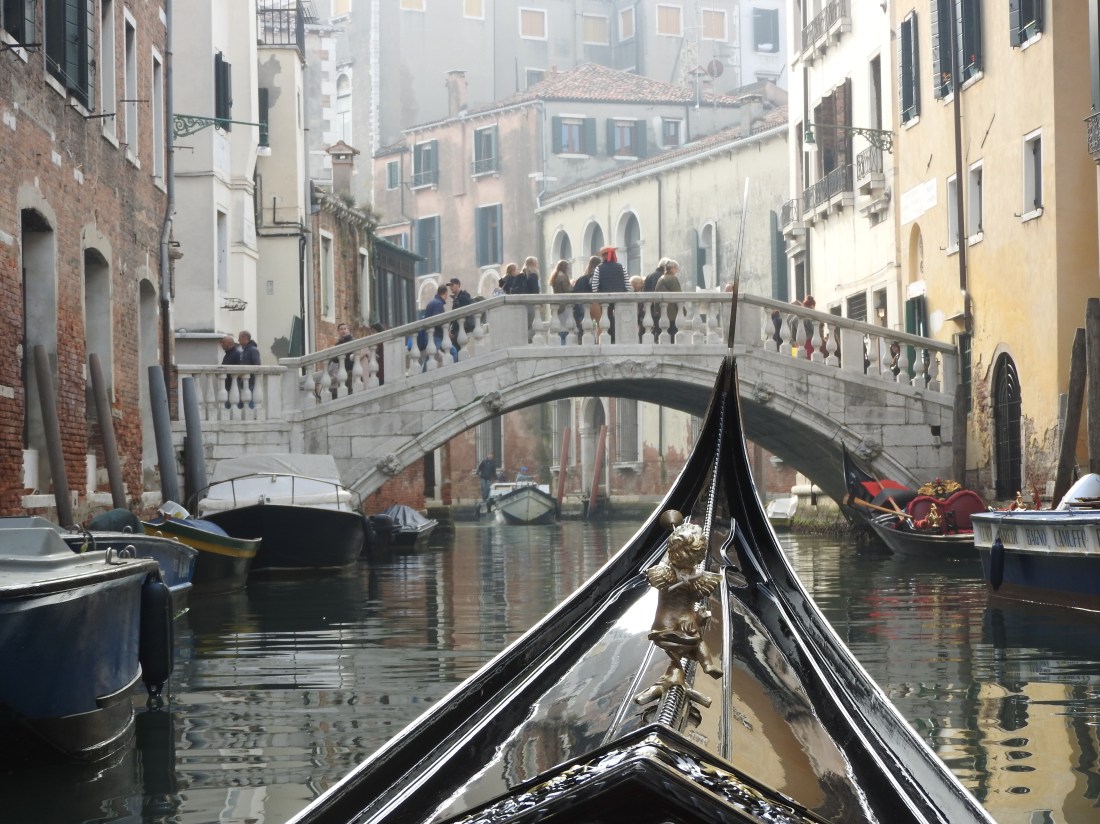
Finding a map on my phone I located the jetty and made my way over, passing a funeral home whose staff were busy loading a coffin into a hearse, before I arrived at the correct place.  It was obvious which jetty was the right one as it had a lift attached to it, looking like a platform type lift that wheelchair users will have seen and used in various places.  In the water a gondola, beautifully turned out with polished wooden surfaces and glinting brass adornments.

I approached the 2 men on the jetty and explained that I had booked a gondola, asking if either of them were the gondolier.  Disappointingly neither was wearing the stereotypical striped jersey and hat but one chap was indeed the gondolier.  Together they prepared the lift for use, which involved obtaining a wired industrial type remote control and plugging it in.  While one chap operated the controls the other helped position me on the lift and, after being swung out away from the jetty and over the water, I was lowered into the gondola which at first felt a little unnerving, especially on leaving the lift and entering the gondola proper as it was rocking and bobbing about with every movement and felt very unstable.

The gondolier then started positioning me in the boat, explaining that they are built asymmetrical for stability once the gondolier takes his position and starts to propel the boat.  This was something I’d never noticed or heard of before but once mentioned I could discern that the front wasn’t quite straight.

Whilst the gondolier was making everything ready for my trip the gondola was rocking a fair bit and I found myself holding onto the frame of my chair tightly, whilst realising that that wouldn’t be any help if the boat did overturn.

When he was ready we departed the jetty and headed out into the grand canal.  The width, amount of traffic and noise was staggering.  I noticed that as we were in motion the stability of the boat settled down and it felt very secure.  I started to enjoy the ride, taking photos and even a few seconds of video.  Here I was, riding a gondola in Venice!  Quite possibly a once-in-a-lifetime experience.  The architecture of the buildings lining the sides of the canal and the light fittings at corners were stunning.

After a while on the grand canal we turned off and into narrower canals with quieter waters, where I spotted and marvelled at bins being emptied by workers on boats and a fire service garage full of red boats.

Even here in the quieter canals there were a good variety of boats, from other gondolas to pleasure cruisers and at one point a power boat, chugging past gently.

I did notice, as we passed under bridges, that a lot of people would turn, looking in our direction and smile, reaching for cameras and phones.  By the same token I was smiling back and taking photos of the bridges.

I had booked an hour-long journey and that hour flew by.  Soon we headed back to the jetty and, after being hauled out of the gondola by the lift, I was back on solid ground and handed over my 160 Euro to the lift operator.  Pricey but worth it.

I headed back to my car and, starting the engine and getting myself together, I reflected on the fact that I had just taken a gondola ride around Venice, which is pretty awesome in itself, and I had done it without having to leave my chair.

I drove away, back over the bridge to the mainland and on, toward my next adventure.


Experiencing the Caledonian Sleeper

For those that don’t know, the Caledonian Sleeper is one of only 2 sleeper train services still running in the UK, the other being the Night Riviera which goes from London to Penzance.  The Caledonian Sleeper runs services every night except Saturday from various parts of the Scottish highlands and lowlands to London (and back again), via a few other stopping points.  It had long been a dream of mine to travel on the sleeper and so last year I made that dream a reality.  This was my experience.

After packing clothing, overnight items, my APAP machine and some snacks and drinks I drove from Yorkshire to Fort William, rode the sleeper to London, stayed overnight and visited the British Library before riding the sleeper back to Fort William and then driving back home.

Such a great experience. First the road trip through the highlands, where I used to live and which was stunning. Then arriving at the station to find that the platform staff already had a ramp out for me right next to the accessible cabin (wheelchair user).

20180330_193409

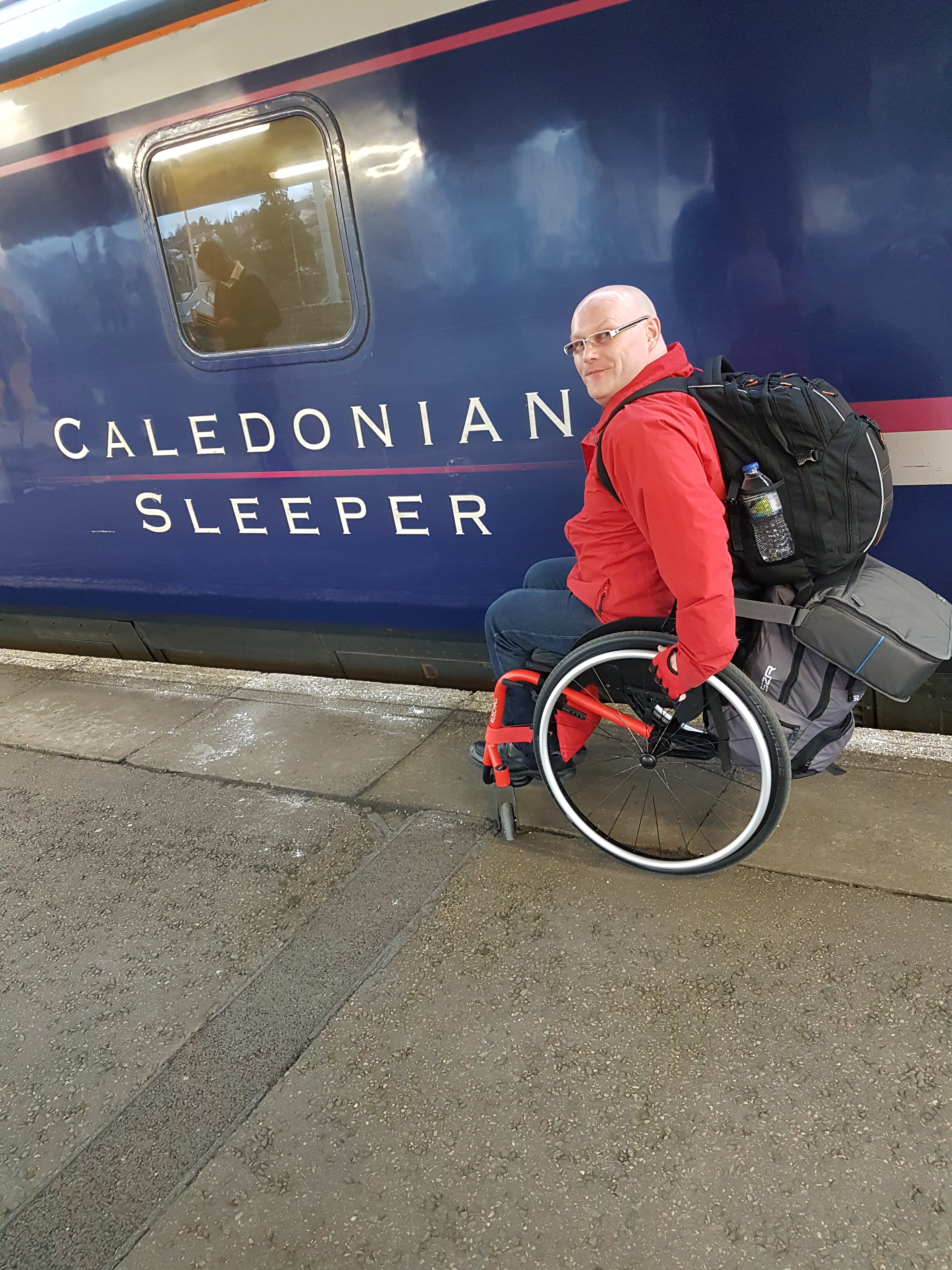
I asked one of the on board staff if they’d mind taking a photo of me by the name of the train and they duly obliged, with a smile and a bit of chatter.  I handed the lass a fiver as a thank you.

20180330_192629

Boarded the train and was shown around the cabin, all the features and the toilet etc by a train manager, toiletries and a food menu laid out on the bunk, all presented nicely and bottles of water in a rack by the window.

Made myself comfortable and had a look around, opened a bottle of water when the train manager came back with a coffee for me and asked if I’d decided on breakfast. I chose the scottish cooked breakfast and coffee and was left alone again, with the train manager advising that if I wanted or needed anything I just had to press the call button as my wheelchair wouldn’t fit down the aisles to get to the lounge or restaurant cars.

Eventually we set off (I’d arrived well early in order to make sure nothing went wrong) and it was a lot of fun being able to watch the highlands slide by outside from my own private room, being able to lay down and watch movies on my laptop whilst travelling. I’d brought a couple of beers with me and drank those before turning in for the night as it got darker.

I didn’t get much sleep – the journey itself was smooth and relatively quiet considering, but there was the odd time where there would be a jolt that woke me, plus I was so excited as this was something I’d wanted to do for years – I was like a kid at Christmas!

Approaching London in the morning I was brought breakfast in my room and there was my only disappointment of the entire experience – I’d expected it would be served on a plate and freshly cooked. What I received was a cardboard box with greasy congealed food inside, most of which I ended up leaving. That was the only disappointment though and I resolved that on my return journey I would opt for the porridge – can’t go far wrong with that.

20180331_074746

I arrived at London and was surprised to see the ramp had been placed at the door before I’d even left my cabin and I was straight out onto the platform where a chap with an electric buggy thing asked me if I needed a hand with my luggage (2 backpacks and my APAP machine).  I snapped a couple of shots of the loco that had pulled the train.

Now to the return journey. Arriving at the station which was eerily almost empty, I promptly fell over backwards in my chair whilst trying to reach for a drink from one of my backpacks and instantly had people helping me up again. The signs announced that the train was delayed but no big deal – I wasn’t in any rush, so I got a pasty from a pasty shop I found (horribly overpriced and hotter than the sun!) and chilled for a bit.

When the train arrived and the staff started boarding I was again shown to my coach where there was a ramp waiting, shown to my cabin and asked if I needed any help which, since I’d already travelled down on the sleeper I didnt. For this journey my cabin had been stocked with more bottled water and the toiletries that first class passengers get (I’d only booked standard class). I assumed that they’d either run out of the standard toiletries (which are nice enough) or that they had been put in my cabin by mistake but either way it was a nice surprise.

Just after departing I was again brought a coffee and the train manager gave the spiel about pressing the call button if I wanted anything. I told him that, although I had ordered and paid for the scottish cooked breakfast, I’d really rather have the porridge and coffee come the morning, which he made a note of.

Again as it got darker I turned in and again I didn’t sleep much – still hyped up that I was once again travelling up the country on a train in my own private cabin with a bed to sleep in. I found it fascinating watching the station staff and train crew re-arranging the train at various points during the night (it splits into 3 somewhere) and I had a chuckle as we departed Leeds station – I could have left the train there and been home not long after.

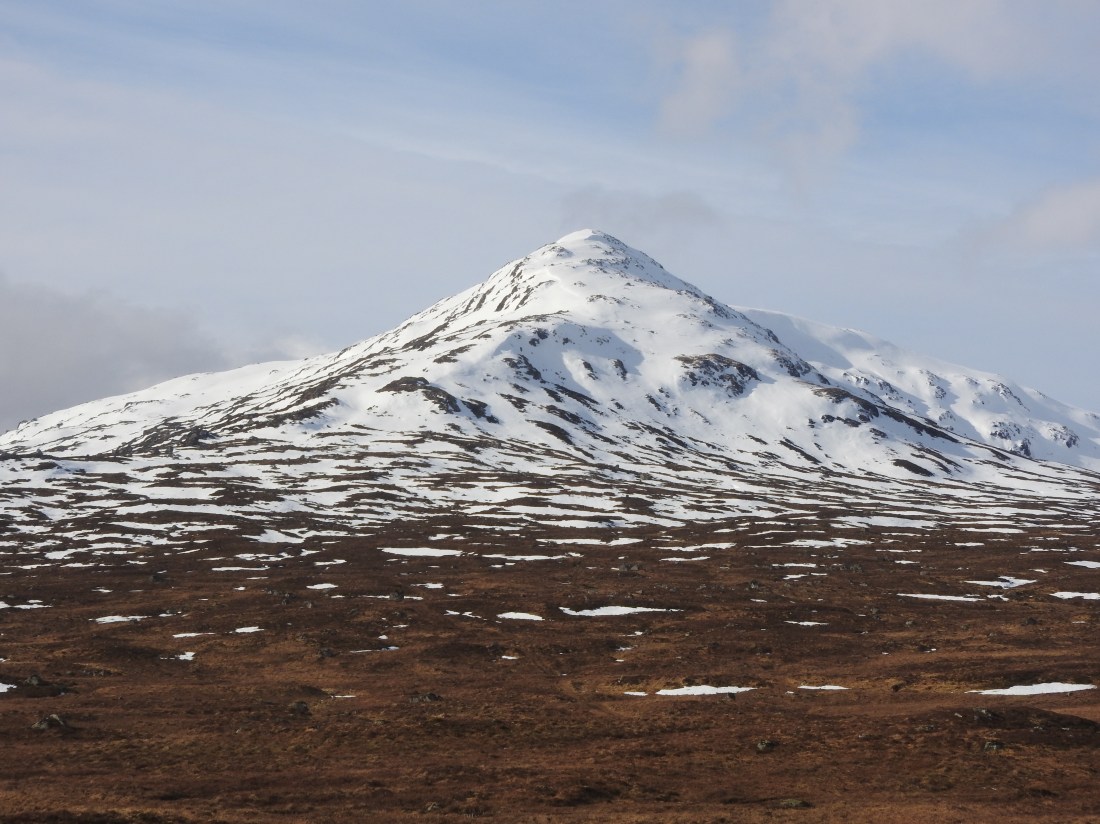
I was awakened in the morning by the train manager entering the cabin – I’d requested breakfast at 7 and he’d spent some time knocking on the door apparently before opening it himself, I must have been fast asleep. I was presented with my porridge and coffee, which I enjoyed as we rolled across Rannoch Moor – the sun shining on the snow-covered mountain tops and mile after mile of empty moorland, until I spotted a pair of walkers hiking across the scene.

I spent some time outside of my cabin opening the windows in the vestibule and getting some brilliant photos and videos as the train meandered it’s way back towards Fort William. I got speaking to an American woman who had brought her little girl on holiday and decided to ride the sleeper as part of that.

Returning to my cabin I washed and dressed, packed my gear away and made ready to leave.

On arrival at Fort William there was the chap on the platform stood waiting with the ramp, like a soldier on parade I remember thinking. Train stopped and I loaded my baggage on my chair and left the cabin. I asked the chap with the ramp if he would mind grabbing a quick snap of me as I came down the ramp. He obliged with a smile and I gave him a fiver in appreciation.

20180402_110843

Leaving the station entrance I was glad to see my Volvo, still sitting there patiently and fully intact, waiting to take me home.

20180330_183116

Driving back over Rannoch Moor, which I’d gone through on the train not long before, I reflected on what a great experience I’d had and decided I’d have to do it again when the new rolling stock was in use.