So back in November I spotted a Facebook post which mentioned that CRIPtic Arts in London were looking for writers for a project named the Crip Monologues.
Writers were invited to pitch ideas at the CRIPtic team and from those pitches 12 would be chosen to develop a script for a 10-15 minute monologue, with the subject being scrutiny; people who are stared at when they enter a room or go shopping; people who look different to the “norm”.
I was one of the 12 commissioned, which was obviously exciting for me, and I quickly had to learn how to write a script, having never done this previously. The commission for this piece was paid into my bank a few days after completion and that then made me officially a paid writer. For the first time in my life someone saw value in my writing! This has reawakened the buzz inside of me to get a book finished and out there. I believe the Crip Monologues will be performed this year (2024.)
We’ve all felt it — that surge of energy when motivation courses through our veins. It’s the fuel that powers us to tackle our goals, the wind in our sails pushing us towards success. On these days, we’re unstoppable, checking off tasks with a vigour that seems to come from a boundless well.
The Lows of Demotivation
But then, there are the other days. The odd ones where that well of motivation seems to have dried up overnight. We wake up feeling like we’re wading through treacle, every task an insurmountable mountain. It’s normal, yet it can make us feel isolated, as if we’re the only ones struggling while the rest of the world charges ahead.
Understanding the Cycle
It’s crucial to recognise that motivation isn’t constant; it’s a cycle. Like the ocean’s tides, it ebbs and flows. Accepting this can be liberating. It means that feeling down or unmotivated isn’t a failure — it’s part of the human experience.
Strategies for the Low Days
So, what can we do when motivation is scarce? Here are a few strategies:
Start small: Tackle the smallest task on your list. Completing it can give you a sense of achievement and might just kickstart your engine.
Seek inspiration: Sometimes, we need external sources to light our internal fire. Read a book, listen to a podcast, or watch a TED talk — anything that resonates with you.
Connect with others: Reach out to a friend or colleague. Often, just talking about our lack of motivation can help dissipate it.
Be kind to yourself: Remember, it’s okay to have off days. Be as compassionate to yourself as you would be to a friend in the same boat.
Embracing the Journey
Motivation is not just about the highs; it’s about learning to navigate the lows. It’s about understanding that our worth isn’t tied to our productivity on any given day. So, on those odd days when you’re feeling down, remember that the tide will turn. The key is to ride the wave, not fight against it.
Along with alexithymia, my autism diagnosis also made me aware of my lack of interoception. This has been a lifelong issue for me.
What is Interoception?
Interoception is our ability to perceive and interpret signals coming from within our own bodies. It’s an internal sense that informs us about the physiological state of our body, such as hunger, thirst, temperature, and internal pain. This sense can be both conscious and subconscious, and it plays a crucial role in maintaining homeostasis and facilitating self-awareness.
The Causes of Interoceptive Dysregulation
Interoceptive dysregulation can arise from a variety of sources. It’s often associated with mental health conditions like anxiety, depression, panic disorder, anorexia nervosa, bulimia nervosa, PTSD, OCD, ADHD, alexithymia, somatic symptom disorder, and illness anxiety disorder. Misrepresentations of internal states or a disconnect between the body’s signals and the brain’s interpretation of those signals are suggested to underlie these conditions.
Treatments and Techniques for Managing Interoception
Several approaches exist to enhance interoceptive awareness and regulation:
Mindfulness and meditation: These practices can enhance one’s awareness of bodily sensations and help regulate emotional responses.
Talking therapies: Cognitive-behavioural therapy (CBT) and other psychotherapies can assist individuals in better understanding and responding to their interoceptive signals.
Interoceptive training: Specific exercises that focus on recognising and responding to internal bodily sensations can be beneficial.
Aligning dimensions of interoceptive experience (Adie): A novel therapy that involves interoceptive heartbeat training to align interoceptive experience.
Conclusion
Interoception is a vital but often overlooked aspect of our sensory experience. By understanding and managing our interoceptive signals, we can improve our emotional regulation and overall mental well-being.
In my autism diagnosis journey, and after several sessions meeting other autistic people through the National Autistic Society for Scotland in their Embrace Autism group sessions, I have come to realise that I can’t, and have never been able, to pinpoint what I’m feeling (emotionally) at any given time. This is a condition linked to autism that is named Alexithymia.
What is Alexithymia?
Alexithymia, often described as “emotional blindness,” is a condition characterised by difficulty in identifying, expressing, and describing emotions. It’s not just about being less emotional; it’s about having a hard time understanding what you’re feeling at any given moment. People with alexithymia might find themselves confused when asked how they feel, or they may struggle to recognise the emotions of others.
The Roots of Alexithymia
Although not fully understood, the causes of alexithymia could be influenced by genetics, brain structure, and early life experiences. Some studies suggest it could be related to damage in the insula, a part of the brain involved in empathy and emotional awareness. It’s also associated with various mental health conditions, including depression, anxiety, and autism spectrum disorders.
Living with Alexithymia
For those with alexithymia, everyday interactions can be challenging. They might appear distant or uninterested because they don’t express emotions in a typical way. This can lead to misunderstandings in personal relationships and difficulties in social situations.
While there’s no specific treatment for alexithymia, therapy can help improve emotional awareness and expression. Techniques like cognitive-behavioural therapy (CBT) and mindfulness practices can assist individuals in better understanding their own emotions and the emotions of others.
Conclusion
Alexithymia is a complex condition that affects how people perceive and express emotions. By recognising its presence and understanding its implications, we can create more supportive environments for those who experience the world differently.
I have a Supra-Pubic Catheter. This is a tube that is inserted into a hole in my lower abdomen, just beneath my belly button, and directly into my bladder. I had the surgery for this in May 2018 after approximately 10 years of self-catheterising, which is inserting a tube into the urethra and into the bladder several times per day in order to drain the bladder. My hands got too unsteady to do this without causing significant pain and trauma. I made the decision to have surgery for an SPC and I’ve never looked back. Every 8 weeks a district nurse calls by my home to change the catheter.
Urinary catheters can have various benefits for people who have difficulty peeing naturally. They can:
Seek support if you need it. You should get regular check-ups from your doctor or nurse to monitor your condition and adjust your treatment if needed. You should also get information and advice from various sources, such as NHS, Bladder & Bowel UK, The Urology Foundation, ERIC, etc.
Urinary catheters are flexible tubes that are used to drain the bladder and collect urine in a drainage bag or a valve. They can be inserted through the urethra or through a small opening in the lower abdomen. There are different types of urinary catheters, depending on how long they are needed and how they are inserted. Urinary catheters can have various benefits for people who have difficulty peeing naturally, but they can also have some risks and challenges. To reduce these, you should choose the right type of catheter for your needs and preferences, keep your catheter clean and well-maintained, drink plenty of fluids, and seek support if you need it.
Because of my MS, in 2017 I found I was struggling with hearing. Specifically, in hearing people speaking to me in noisy environments and not being able to hear people speaking to me if I wasn’t facing them. I also found I’ve been lipreading for a number of years without even being aware of it.
Infections: Some viral or bacterial infections, such as measles, mumps, rubella, meningitis, or syphilis, can infect the inner ear or the nerve pathways and cause inflammation and damage. This can result in sudden or progressive sensorineural deafness.
Ototoxic drugs: Some medications, such as certain antibiotics, chemotherapy drugs, or anti-inflammatory drugs, can have toxic effects on the inner ear or the nerve pathways and cause temporary or permanent sensorineural deafness. This is called ototoxicity and can be prevented by monitoring the dosage and side effects of these drugs.
Other conditions: Some medical conditions, such as diabetes, high blood pressure, thyroid disorders, autoimmune diseases, or tumours, can affect the blood supply or the function of the inner ear or the nerve pathways and cause sensorineural deafness.
In my case the reason for my deafness was nerve damage caused by my MS.
Sensorineural deafness can affect one or both ears and can range from mild to profound. It can also affect different frequencies of sound differently. People with sensorineural deafness may experience:
Difficulty hearing soft or distant sounds
Difficulty understanding speech in noisy environments
Difficulty hearing high-pitched sounds, such as children’s voices or birdsong
Tinnitus: a ringing, buzzing, hissing, or humming sound in the ears
Vertigo: a sensation of spinning or losing balance
Hyperacusis: an increased sensitivity to loud sounds
Sensorineural deafness can have a significant impact on your quality of life and well-being. It can affect your communication, social interaction, education, employment, safety, and mental health. However, there are ways to cope with sensorineural deafness and improve your hearing experience. These include:
Hearing aids: These are devices that fit in or behind your ear and amplify the sounds around you. They are programmed to suit your level and type of hearing loss and can be adjusted to different situations. Hearing aids can help you hear better and reduce your tinnitus. You can get hearing aids from the NHS or from a private provider.
Cochlear implants: These are devices that are surgically implanted in your inner ear and stimulate the auditory nerve directly with electrical signals. They bypass the damaged hair cells and nerve fibres and provide sound information to your brain. Cochlear implants can help you hear better and understand speech more clearly. They are suitable for people with severe to profound sensorineural deafness who do not benefit from hearing aids.
Assistive listening devices: These are devices that enhance the sound input from specific sources, such as telephones, TVs, radios, or microphones. They can be used with or without hearing aids or cochlear implants. They include induction loops, infrared systems, FM systems, Bluetooth devices, amplified phones, TV listeners, etc.
Communication strategies: These are techniques that help you communicate more effectively with others. They include speaking clearly and slowly; facing the speaker; using lipreading; using gestures; using written notes; choosing quiet and well-lit places; asking for repetition or clarification; etc.
Support services: These are services that provide information, advice, guidance, and support for people with sensorineural deafness and their families. They include audiologists, hearing therapists, speech and language therapists, counsellors, social workers, teachers of the deaf, etc.
Support groups: These are groups that offer peer support, emotional support, and social activities for people with sensorineural deafness and their families. They include local groups, national groups, online groups, etc.
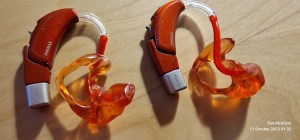
The audiologist who I saw initially prescribed a pair of Oticon hearing aids, and then upgraded them to Phonak aids, allowing me to keep the Oticons as a spare set. All my aids are red, my favourite colour, as I am bald and they are always visible. The NHS doesn’t usually allow adults to choose colours but they made an exception for me when I explained my reasons. My moulds (the bit that sits inside the ear) are also red. The champagne-coloured items attached to the bottom of my aids in the picture below are Roger X receivers. They are paired with a set of portable microphones that I can take to meetings and use to hear speakers more clearly.
My aids are programmed to my personal audiogram to allow me to hear as normally as possible. They are also programmed with some optional settings. There is a bass boost feature that is turned on, as well as a speech-in-noise setting that allows me to filter out some background noise and hear speech in front of me. This is most effective when I am actually looking at the person speaking to me. There is also the good old T-coil setting programmed in, which allows the aids to connect to a loop system where available.
Sensorineural deafness is a type of hearing loss that affects the inner ear or the nerve pathways that carry sound signals to the brain. It can have various causes, such as ageing, noise exposure, genetic factors, infections, ototoxic drugs, or other conditions. Sensorineural deafness can affect your quality of life and well-being, but there are ways to cope with it and improve your hearing experience. These include hearing aids, cochlear implants, assistive listening devices, communication strategies, support services, and support groups.












 Journeys In Words And On Wheels
You must be logged in to post a comment.