Using hearing aids: tips and advice

Hearing aids are small devices that fit in or behind your ear and can help you to hear sound louder and more clearly. They are battery-operated and have a microphone that picks up the sounds around you. These sounds are processed and amplified electronically, passed on to a receiver and converted back into sounds that you can hear.
Hearing aids can improve your quality of life by helping you to communicate, enjoy social activities, and stay safe and independent. However, they may also require some adjustment and maintenance to get the best results. Here are some tips and advice on using hearing aids:

Using hearing aids can help you hear better and improve your quality of life. However, they may also require some adjustment and maintenance to get the best results. By following these tips and advice on using hearing aids, you can make the most of your hearing experience.

What is Sensorineural Deafness and how does it affect people?

Because of my MS, in 2017 I found I was struggling with hearing.  Specifically, in hearing people speaking to me in noisy environments and not being able to hear people speaking to me if I wasn’t facing them.  I also found I’ve been lipreading for a number of years without even being aware of it.

Sensorineural deafness, also known as sensorineural hearing loss (SNHL), is a type of hearing loss that affects the inner ear or the nerve pathways that carry sound signals to the brain. It is the most common cause of permanent hearing loss in adults, accounting for more than 90% of cases.

Sensorineural deafness can have various causes, such as:

In my case the reason for my deafness was nerve damage caused by my MS.

Sensorineural deafness can affect one or both ears and can range from mild to profound. It can also affect different frequencies of sound differently. People with sensorineural deafness may experience:

  • Difficulty hearing soft or distant sounds
  • Difficulty understanding speech in noisy environments
  • Difficulty hearing high-pitched sounds, such as children’s voices or birdsong
  • Tinnitus: a ringing, buzzing, hissing, or humming sound in the ears
  • Vertigo: a sensation of spinning or losing balance
  • Hyperacusis: an increased sensitivity to loud sounds

Sensorineural deafness can have a significant impact on your quality of life and well-being. It can affect your communication, social interaction, education, employment, safety, and mental health. However, there are ways to cope with sensorineural deafness and improve your hearing experience. These include:

  • Hearing aids: These are devices that fit in or behind your ear and amplify the sounds around you. They are programmed to suit your level and type of hearing loss and can be adjusted to different situations. Hearing aids can help you hear better and reduce your tinnitus. You can get hearing aids from the NHS or from a private provider.
  • Cochlear implants: These are devices that are surgically implanted in your inner ear and stimulate the auditory nerve directly with electrical signals. They bypass the damaged hair cells and nerve fibres and provide sound information to your brain. Cochlear implants can help you hear better and understand speech more clearly. They are suitable for people with severe to profound sensorineural deafness who do not benefit from hearing aids.
  • Assistive listening devices: These are devices that enhance the sound input from specific sources, such as telephones, TVs, radios, or microphones. They can be used with or without hearing aids or cochlear implants. They include induction loops, infrared systems, FM systems, Bluetooth devices, amplified phones, TV listeners, etc.
  • Communication strategies: These are techniques that help you communicate more effectively with others. They include speaking clearly and slowly; facing the speaker; using lipreading; using gestures; using written notes; choosing quiet and well-lit places; asking for repetition or clarification; etc.
  • Support services: These are services that provide information, advice, guidance, and support for people with sensorineural deafness and their families. They include audiologists, hearing therapists, speech and language therapists, counsellors, social workers, teachers of the deaf, etc.
  • Support groups: These are groups that offer peer support, emotional support, and social activities for people with sensorineural deafness and their families. They include local groups, national groups, online groups, etc.

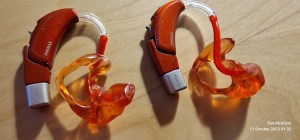
The audiologist who I saw initially prescribed a pair of Oticon hearing aids, and then upgraded them to Phonak aids, allowing me to keep the Oticons as a spare set.  All my aids are red, my favourite colour, as I am bald and they are always visible.  The NHS doesn’t usually allow adults to choose colours but they made an exception for me when I explained my reasons.  My moulds (the bit that sits inside the ear) are also red.  The champagne-coloured items attached to the bottom of my aids in the picture below are Roger X receivers.  They are paired with a set of portable microphones that I can take to meetings and use to hear speakers more clearly.

My aids are programmed to my personal audiogram to allow me to hear as normally as possible. They are also programmed with some optional settings. There is a bass boost feature that is turned on, as well as a speech-in-noise setting that allows me to filter out some background noise and hear speech in front of me. This is most effective when I am actually looking at the person speaking to me. There is also the good old T-coil setting programmed in, which allows the aids to connect to a loop system where available.

Sensorineural deafness is a type of hearing loss that affects the inner ear or the nerve pathways that carry sound signals to the brain. It can have various causes, such as ageing, noise exposure, genetic factors, infections, ototoxic drugs, or other conditions. Sensorineural deafness can affect your quality of life and well-being, but there are ways to cope with it and improve your hearing experience. These include hearing aids, cochlear implants, assistive listening devices, communication strategies, support services, and support groups.

What is Multiple Sclerosis and how does it affect people?

Multiple Sclerosis (MS) is a condition that affects the brain and spinal cord, causing damage to the nerves that carry messages between them. This damage can lead to a variety of symptoms, such as problems with vision, movement, sensation, balance, thinking and emotions. MS is a lifelong condition that can sometimes cause serious disability, although it can also be mild or moderate in some cases. There is no cure for MS, but treatments can help manage the symptoms and reduce the frequency of relapses.

MS affects more than 2.8 million people worldwide and around 130,000 people in the UKIt is one of the most common causes of neurological disability in young adultsIt is more common in women than men, and usually starts in the 20s, 30s or 40sThe exact cause of MS is unknown, but it is thought to involve a combination of genetic and environmental factors that trigger an abnormal immune response against the myelin sheath, the protective layer that surrounds the nerve fibres.

MS is a complex and unpredictable condition that can affect people in different ways. There are four main types of MS:

  • Relapsing remitting MS (RRMS): This is the most common type of MS, affecting around 85% of people with MS. People with RRMS have episodes of new or worsening symptoms, called relapses, followed by periods of recovery, called remissions. The symptoms may disappear completely or partially after a relapse, but some may persist or get worse over time.
  • Secondary progressive MS (SPMS): This type of MS usually develops after many years of RRMS. People with SPMS have a gradual worsening of symptoms over time, with or without occasional relapses. About two-thirds of people with RRMS will develop SPMS within 15 years of diagnosis.
  • Primary progressive MS (PPMS): This type of MS affects about 10-15% of people with MS. People with PPMS have a steady increase in symptoms from the onset, without any relapses or remissions. PPMS tends to start later than other types of MS, usually in the 40s or 50s.
  • Progressive relapsing MS (PRMS): This is a rare type of MS, affecting less than 5% of people with MS. People with PRMS have a steady progression of symptoms from the onset, as well as occasional relapses. PRMS can start at any age.

The symptoms of MS vary widely from person to person and can affect any part of the body. Some of the most common symptoms include:

  • Fatigue: This is one of the most common and troublesome symptoms of MS. It is an overwhelming sense of exhaustion that can make everyday activities difficult or impossible.
  • Vision problems: These can include blurred vision, double vision, loss of vision, colour blindness, eye pain or flashes of light. These are often caused by inflammation or damage to the optic nerve (optic neuritis).
  • Numbness and tingling: These are abnormal sensations that can affect different parts of the body, such as the arms, legs or trunk. They are caused by damage to the sensory nerves.
  • Muscle spasms, stiffness and weakness: These are problems with muscle function that can affect movement, balance and co-ordination. They are caused by damage to the motor nerves.
  • Pain: This can be acute or chronic pain that can affect different parts of the body. It can be caused by nerve damage (neuropathic pain) or muscle spasms (musculoskeletal pain).
  • Problems with thinking, learning and planning: These are cognitive problems that can affect memory, attention, concentration, reasoning and problem-solving. They are caused by damage to the brain tissue.
  • Depression and anxiety: These are emotional problems that can affect mood, motivation and self-esteem. They can be caused by the impact of living with MS or by changes in brain chemistry.
  • Sexual problems: These can include reduced libido, erectile dysfunction, vaginal dryness or difficulty reaching orgasm. They can be caused by physical or psychological factors.
  • Bladder problems: These can include urinary urgency, frequency, incontinence or retention. They can be caused by damage to the nerves that control bladder function.
  • Bowel problems: These can include constipation, diarrhoea or faecal incontinence. They can be caused by damage to the nerves that control bowel function.
  • Speech and swallowing difficulties: These can include slurred speech, difficulty finding words or swallowing food or drink. They can be caused by damage to the nerves that control speech and swallowing.

The severity and impact of these symptoms can vary from person to person and over time. Some people may only experience mild or occasional symptoms, while others may have more severe or frequent symptoms that affect their quality of life. The symptoms can also be influenced by factors such as stress, infection, temperature, medication or menstruation.

MS can be a challenging condition to live with, but there are ways to manage the symptoms and cope with the changes. There are various treatments available for MS, such as medication, therapy, surgery or complementary therapies. These can help reduce inflammation, prevent relapses, slow down progression, relieve symptoms or improve function. There are also support services and resources available for people with MS and their families, such as MS nurses, physiotherapists, occupational therapists, counsellors, social workers or support groups. These can provide information, advice, guidance, practical help or emotional support.

MS is not a fatal condition, but it can affect life expectancy to some extent. The average life expectancy for people with MS is about 5 to 10 years lower than the general population. However, this can vary depending on the type of MS, the age of onset, the severity of symptoms and the availability of treatment. Many people with MS can live long and fulfilling lives with the right care and support.

If you want to learn more about MS, you can visit the following websites:

  • MS Society: A UK charity that provides information, support and research for people affected by MS.
  • MS Trust: A UK charity that provides information, education and specialist services for people living with MS.
  • NHS: The UK’s national health service that provides information and advice on health conditions and treatments.