Because of my MS, in 2017 I found I was struggling with hearing. Specifically, in hearing people speaking to me in noisy environments and not being able to hear people speaking to me if I wasn’t facing them. I also found I’ve been lipreading for a number of years without even being aware of it.
Sensorineural deafness, also known as sensorineural hearing loss (SNHL), is a type of hearing loss that affects the inner ear or the nerve pathways that carry sound signals to the brain. It is the most common cause of permanent hearing loss in adults, accounting for more than 90% of cases.
Sensorineural deafness can have various causes, such as:
- Ageing: As we get older, the hair cells and nerve fibres in the inner ear gradually deteriorate and lose their ability to transmit sound. This is called presbycusis and affects about one in three people over 65.
- Noise exposure: Loud noises, such as music, machinery, firearms, or explosions, can damage the hair cells and nerve fibres in the inner ear. This is called noise-induced hearing loss (NIHL) and can occur after a single exposure to a very loud sound or repeated exposure to moderately loud sounds over time.
- Genetic factors: Some people inherit genes that make them more susceptible to sensorineural deafness or cause specific syndromes that affect hearing, such as Usher syndrome, Waardenburg syndrome, or Pendred syndrome.
- Infections: Some viral or bacterial infections, such as measles, mumps, rubella, meningitis, or syphilis, can infect the inner ear or the nerve pathways and cause inflammation and damage. This can result in sudden or progressive sensorineural deafness.
- Ototoxic drugs: Some medications, such as certain antibiotics, chemotherapy drugs, or anti-inflammatory drugs, can have toxic effects on the inner ear or the nerve pathways and cause temporary or permanent sensorineural deafness. This is called ototoxicity and can be prevented by monitoring the dosage and side effects of these drugs.
- Other conditions: Some medical conditions, such as diabetes, high blood pressure, thyroid disorders, autoimmune diseases, or tumours, can affect the blood supply or the function of the inner ear or the nerve pathways and cause sensorineural deafness.
In my case the reason for my deafness was nerve damage caused by my MS.
Sensorineural deafness can affect one or both ears and can range from mild to profound. It can also affect different frequencies of sound differently. People with sensorineural deafness may experience:
- Difficulty hearing soft or distant sounds
- Difficulty understanding speech in noisy environments
- Difficulty hearing high-pitched sounds, such as children’s voices or birdsong
- Tinnitus: a ringing, buzzing, hissing, or humming sound in the ears
- Vertigo: a sensation of spinning or losing balance
- Hyperacusis: an increased sensitivity to loud sounds
Sensorineural deafness can have a significant impact on your quality of life and well-being. It can affect your communication, social interaction, education, employment, safety, and mental health. However, there are ways to cope with sensorineural deafness and improve your hearing experience. These include:
- Hearing aids: These are devices that fit in or behind your ear and amplify the sounds around you. They are programmed to suit your level and type of hearing loss and can be adjusted to different situations. Hearing aids can help you hear better and reduce your tinnitus. You can get hearing aids from the NHS or from a private provider.
- Cochlear implants: These are devices that are surgically implanted in your inner ear and stimulate the auditory nerve directly with electrical signals. They bypass the damaged hair cells and nerve fibres and provide sound information to your brain. Cochlear implants can help you hear better and understand speech more clearly. They are suitable for people with severe to profound sensorineural deafness who do not benefit from hearing aids.
- Assistive listening devices: These are devices that enhance the sound input from specific sources, such as telephones, TVs, radios, or microphones. They can be used with or without hearing aids or cochlear implants. They include induction loops, infrared systems, FM systems, Bluetooth devices, amplified phones, TV listeners, etc.
- Communication strategies: These are techniques that help you communicate more effectively with others. They include speaking clearly and slowly; facing the speaker; using lipreading; using gestures; using written notes; choosing quiet and well-lit places; asking for repetition or clarification; etc.
- Support services: These are services that provide information, advice, guidance, and support for people with sensorineural deafness and their families. They include audiologists, hearing therapists, speech and language therapists, counsellors, social workers, teachers of the deaf, etc.
- Support groups: These are groups that offer peer support, emotional support, and social activities for people with sensorineural deafness and their families. They include local groups, national groups, online groups, etc.
The audiologist who I saw initially prescribed a pair of Oticon hearing aids, and then upgraded them to Phonak aids, allowing me to keep the Oticons as a spare set. All my aids are red, my favourite colour, as I am bald and they are always visible. The NHS doesn’t usually allow adults to choose colours but they made an exception for me when I explained my reasons. My moulds (the bit that sits inside the ear) are also red. The champagne-coloured items attached to the bottom of my aids in the picture below are Roger X receivers. They are paired with a set of portable microphones that I can take to meetings and use to hear speakers more clearly.
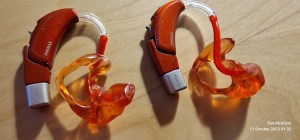
My aids are programmed to my personal audiogram to allow me to hear as normally as possible. They are also programmed with some optional settings. There is a bass boost feature that is turned on, as well as a speech-in-noise setting that allows me to filter out some background noise and hear speech in front of me. This is most effective when I am actually looking at the person speaking to me. There is also the good old T-coil setting programmed in, which allows the aids to connect to a loop system where available.
Sensorineural deafness is a type of hearing loss that affects the inner ear or the nerve pathways that carry sound signals to the brain. It can have various causes, such as ageing, noise exposure, genetic factors, infections, ototoxic drugs, or other conditions. Sensorineural deafness can affect your quality of life and well-being, but there are ways to cope with it and improve your hearing experience. These include hearing aids, cochlear implants, assistive listening devices, communication strategies, support services, and support groups.
 Journeys In Words And On Wheels
You must be logged in to post a comment.