As many motorists will have noticed recently insurance premiums have risen astronomically and many are asking why.
I have a theory.
In 2010, while driving to the shop one wintery evening I came to a junction controlled by traffic lights, and my light was red so I obviously stopped. To my left a Morrisons truck also stopped. On getting a green light, I pulled forward a bit as I was turning right and traffic coming the other way had priority. The Morrisons truck to my left started turning left, and the trailer hit an icy patch and slid into the side of my car, destroying the nearside wing mirror and leaving scratches and scrapes on the front passenger door.
Next day I called the insurance company, gave them the details of what had happened, they advised that not only did they cover me but coincidentally they also covered the Morrisons fleet as well. That same day they had a replacement car out to me and collected my car to be repaired. The place that would be doing the repairs took it on a flatbed truck.
A couple of weeks later my car was returned to me with the repairs having been done. The replacement car was taken away and it was all done and dusted.
Cut to 13 years later and compare that experience with my latest one after a minor accident. Driving from my home in Scotland to my Mum and Stepdad’s in Wales, I stopped off at Todhills rest area on the M6 for a coffee. On leaving the area I began to accelerate down the slip road to rejoin the motorway when a truck driver in front decided to stop his truck, on the slip road, open his cab door in order to empty his coffee or tea mug outside. I’d moved over to pass him when the bottom corner of his door made contact with my car, hitting it just below roof level, denting the A pillar and the front passenger door, shattering the glass in that door, leaving paint on the B and C pillars and leaving gouges out of the rear quarter glass.
By this point I was almost back on the motorway so it wouldn’t have been safe to stop, I had to keep going. When I got to Wales I could get out and see the extent of the damage. Again I called the insurance company that same day and gave them the details. They had a hire car out to me the next day and said they’d arrange for a repairer to collect my car from my home and get it repaired.
So I waited. And then I waited some more. And more. After 4 weeks a company called Motor Repair Network, (MRN) contacted me to arrange to collect my car and said they had a repairer in Glasgow who would do the required work. This repairer was called Activate Accident Repair, (AAR) but my next call didn’t come from them. It came from yet another company called Glasgow Recovery who announced they’d actually been given the task of collecting the car and taking it to Glasgow, to the actual company who would be doing the repairs.
Once the car got to AAR they sent me a link to an online portal where they said I could keep updated on the progress of the repairs, so I watched as it went through assessment, estimated cost, approval from the insurance and then a status of repairs completed. I waited a few days after this status had appeared and then contacted what I thought was the repair company AAR, through their own portal, but it was MRN who responded stating that the repairs had been completed, but that the repairer was awaiting parts which were on back order. So, the repairs are complete, meaning finished, done, finito. But they’re waiting for parts. Parts needed to carry out the repairs. The repairs which are completed. Hmmm.
3 weeks after the status repairs completed had appeared on the portal I got a call from the actual repairers AAR asking if it would be OK to bring my car back that afternoon, which was fine by me as you can probably imagine.
From start to finish the repairs to what was really minor damage had taken almost exactly 3 monthsand involved input from the insurance, the broker or whatever they are, this Motor Repair Network, a recovery company and the actual repairers themselves Activate Accident Repair. 4 companies to do what 2 had been able to do some 13 years prior. And each one of those companies would have needed payment for their part of the job.
Coincidentally, both cars were Peugeot 3008s and both had been damaged by trucks.
But now, disabled people are also facing soaring energy bills, rising food prices and inflation. This is putting them under immense financial pressure and forcing them to make impossible choices between essentials.
The energy crisis and disabled people
One of the main challenges for disabled people is the energy crisis. Many disabled people need to use more energy because of their impairment or condition. For example, they may need to keep their home at a certain temperature, use electric appliances like wheelchairs or hoists, or charge medical devices like ventilators or nebulisers.
But the government’s support for disabled people to cope with the energy crisis is not enough. The Warm Home Discount, which gives eligible households a £150 rebate on their electricity bill, does not cover the extra costs that disabled people face. And the Disability Cost of Living Payment, which gave some disabled people a one-off payment of £150, comes nowhere near the costs. Just as an example, I’m currently paying over £200 per month for gas and electricity.
The impact on disabled people’s health and wellbeing
The cost of living crisis is not only affecting disabled people’s finances, but also their health and wellbeing. Many disabled people are having to sacrifice their basic needs and dignity to cope with the rising costs.
38% of disabled people said they were not using heating when cold because of the cost of living, compared to 26% of non-disabled adults
34% of disabled people said they were buying lower quality food, skipping meals and/or eating less because of the cost of living, compared to 19% of non-disabled adults
20% of disabled people said they were cutting back or stopping showering and bathing because of the cost of living, compared to 9% of non-disabled adults
These choices can have serious consequences for disabled people’s physical and mental health. For example, not heating their home can increase the risk of infections, respiratory problems or hypothermia. Not eating enough or well can affect their immune system, energy levels or medication effectiveness. And not showering or bathing can lead to skin infections, pressure sores or loss of self-esteem.
What needs to change?
The cost of living crisis is making disabled people’s lives harder and more miserable. They deserve better support from the government and the energy sector to meet their needs and live with dignity.
Scope is calling on the government to:
Introduce an Energy Social Tariff for disabled customers that need to use more energy. This would be a discounted rate that accounts for both energy usage and income. Scope suggests that this should apply to households receiving benefits like Disability Living Allowance (DLA), Personal Independence Payment (PIP) or Attendance Allowance, or households under the median income receiving Carer’s Allowance. Scope says that 86% of disabled people support this recommendation.
Increase the funding for local authorities to provide social care and support for disabled people. Scope says that social care is vital for many disabled people to live independently and access essential services. But due to chronic underfunding, many local authorities have tightened their eligibility criteria and reduced their provision. Scope says that 1.5 million older and disabled people are currently going without the care they need.
Scope is also urging the energy regulators and suppliers to:
Extend the Warm Home Discount to more disabled customers who are struggling with their energy bills. Scope says that the current eligibility criteria are too narrow and exclude many disabled people who need the support.
Provide clear and accessible information and advice to disabled customers on how to switch to cheaper tariffs, access grants or schemes, or improve their energy efficiency. Scope says that many disabled people are not aware of their options or find it difficult to access them due to communication barriers or digital exclusion.
Offer flexible and fair payment plans to disabled customers who are in debt or arrears. Scope says that many disabled people are facing aggressive debt collection practices or threats of disconnection from their energy suppliers. Scope says that energy suppliers should take into account disabled people’s circumstances and income when setting up repayment arrangements.
How you can help
If you are a disabled person or know someone who is, you can get help from Scope’s Disability Energy Support service. This is a free and confidential service that can help you with your energy bills, debt, switching, grants and more. You can contact them by phone, email or webchat.
You can also support Scope’s campaign for a fairer deal for disabled people by signing their petition, sharing your story, or donating to their work.
Together, we can make sure that disabled people are not left behind in the cost of living crisis. We deserve to live with dignity, equality and independence.
I have a Supra-Pubic Catheter. This is a tube that is inserted into a hole in my lower abdomen, just beneath my belly button, and directly into my bladder. I had the surgery for this in May 2018 after approximately 10 years of self-catheterising, which is inserting a tube into the urethra and into the bladder several times per day in order to drain the bladder. My hands got too unsteady to do this without causing significant pain and trauma. I made the decision to have surgery for an SPC and I’ve never looked back. Every 8 weeks a district nurse calls by my home to change the catheter.
Urinary catheters can have various benefits for people who have difficulty peeing naturally. They can:
Seek support if you need it. You should get regular check-ups from your doctor or nurse to monitor your condition and adjust your treatment if needed. You should also get information and advice from various sources, such as NHS, Bladder & Bowel UK, The Urology Foundation, ERIC, etc.
Urinary catheters are flexible tubes that are used to drain the bladder and collect urine in a drainage bag or a valve. They can be inserted through the urethra or through a small opening in the lower abdomen. There are different types of urinary catheters, depending on how long they are needed and how they are inserted. Urinary catheters can have various benefits for people who have difficulty peeing naturally, but they can also have some risks and challenges. To reduce these, you should choose the right type of catheter for your needs and preferences, keep your catheter clean and well-maintained, drink plenty of fluids, and seek support if you need it.
Hearing aids can improve your quality of life by helping you to communicate, enjoy social activities, and stay safe and independent. However, they may also require some adjustment and maintenance to get the best results. Here are some tips and advice on using hearing aids:
Wear your hearing aids regularly and gradually build up to wearing them full-time. It may take some time to get used to wearing hearing aids, especially if you have not worn them before or have not worn them for a long time. You may find that sounds are louder or different than you remember. You may also experience some discomfort or feedback (whistling) from your hearing aids. These are normal reactions that will improve over time as your brain adapts to the new sounds. To help with this process, you should wear your hearing aids regularly and gradually increase the amount of time you wear them each day. Start with quiet situations at home, then move on to more challenging environments with background noise or multiple speakers.
Adjust the volume and settings of your hearing aids as needed. Most modern hearing aids have automatic features that adjust the volume and settings according to the sound environment you are in. However, you may still need to manually adjust them sometimes to suit your preferences or needs. For example, you may want to turn up the volume when listening to music or turn down the volume when in a noisy place. You may also want to change the settings when using the phone or watching TV. Some hearing aids have buttons or switches that allow you to do this easily. Others may have remote controls or smartphone apps that let you control your hearing aids wirelessly.
Using hearing aids can help you hear better and improve your quality of life. However, they may also require some adjustment and maintenance to get the best results. By following these tips and advice on using hearing aids, you can make the most of your hearing experience.
Because of my MS, in 2017 I found I was struggling with hearing. Specifically, in hearing people speaking to me in noisy environments and not being able to hear people speaking to me if I wasn’t facing them. I also found I’ve been lipreading for a number of years without even being aware of it.
Infections: Some viral or bacterial infections, such as measles, mumps, rubella, meningitis, or syphilis, can infect the inner ear or the nerve pathways and cause inflammation and damage. This can result in sudden or progressive sensorineural deafness.
Ototoxic drugs: Some medications, such as certain antibiotics, chemotherapy drugs, or anti-inflammatory drugs, can have toxic effects on the inner ear or the nerve pathways and cause temporary or permanent sensorineural deafness. This is called ototoxicity and can be prevented by monitoring the dosage and side effects of these drugs.
Other conditions: Some medical conditions, such as diabetes, high blood pressure, thyroid disorders, autoimmune diseases, or tumours, can affect the blood supply or the function of the inner ear or the nerve pathways and cause sensorineural deafness.
In my case the reason for my deafness was nerve damage caused by my MS.
Sensorineural deafness can affect one or both ears and can range from mild to profound. It can also affect different frequencies of sound differently. People with sensorineural deafness may experience:
Difficulty hearing soft or distant sounds
Difficulty understanding speech in noisy environments
Difficulty hearing high-pitched sounds, such as children’s voices or birdsong
Tinnitus: a ringing, buzzing, hissing, or humming sound in the ears
Vertigo: a sensation of spinning or losing balance
Hyperacusis: an increased sensitivity to loud sounds
Sensorineural deafness can have a significant impact on your quality of life and well-being. It can affect your communication, social interaction, education, employment, safety, and mental health. However, there are ways to cope with sensorineural deafness and improve your hearing experience. These include:
Hearing aids: These are devices that fit in or behind your ear and amplify the sounds around you. They are programmed to suit your level and type of hearing loss and can be adjusted to different situations. Hearing aids can help you hear better and reduce your tinnitus. You can get hearing aids from the NHS or from a private provider.
Cochlear implants: These are devices that are surgically implanted in your inner ear and stimulate the auditory nerve directly with electrical signals. They bypass the damaged hair cells and nerve fibres and provide sound information to your brain. Cochlear implants can help you hear better and understand speech more clearly. They are suitable for people with severe to profound sensorineural deafness who do not benefit from hearing aids.
Assistive listening devices: These are devices that enhance the sound input from specific sources, such as telephones, TVs, radios, or microphones. They can be used with or without hearing aids or cochlear implants. They include induction loops, infrared systems, FM systems, Bluetooth devices, amplified phones, TV listeners, etc.
Communication strategies: These are techniques that help you communicate more effectively with others. They include speaking clearly and slowly; facing the speaker; using lipreading; using gestures; using written notes; choosing quiet and well-lit places; asking for repetition or clarification; etc.
Support services: These are services that provide information, advice, guidance, and support for people with sensorineural deafness and their families. They include audiologists, hearing therapists, speech and language therapists, counsellors, social workers, teachers of the deaf, etc.
Support groups: These are groups that offer peer support, emotional support, and social activities for people with sensorineural deafness and their families. They include local groups, national groups, online groups, etc.
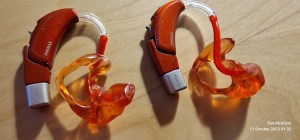
The audiologist who I saw initially prescribed a pair of Oticon hearing aids, and then upgraded them to Phonak aids, allowing me to keep the Oticons as a spare set. All my aids are red, my favourite colour, as I am bald and they are always visible. The NHS doesn’t usually allow adults to choose colours but they made an exception for me when I explained my reasons. My moulds (the bit that sits inside the ear) are also red. The champagne-coloured items attached to the bottom of my aids in the picture below are Roger X receivers. They are paired with a set of portable microphones that I can take to meetings and use to hear speakers more clearly.
My aids are programmed to my personal audiogram to allow me to hear as normally as possible. They are also programmed with some optional settings. There is a bass boost feature that is turned on, as well as a speech-in-noise setting that allows me to filter out some background noise and hear speech in front of me. This is most effective when I am actually looking at the person speaking to me. There is also the good old T-coil setting programmed in, which allows the aids to connect to a loop system where available.
Sensorineural deafness is a type of hearing loss that affects the inner ear or the nerve pathways that carry sound signals to the brain. It can have various causes, such as ageing, noise exposure, genetic factors, infections, ototoxic drugs, or other conditions. Sensorineural deafness can affect your quality of life and well-being, but there are ways to cope with it and improve your hearing experience. These include hearing aids, cochlear implants, assistive listening devices, communication strategies, support services, and support groups.
Coeliac disease is a serious condition that affects the digestive system. It is caused by an abnormal immune response to gluten, a protein found in wheat, barley, rye, and some oats. When people with coeliac disease eat gluten, their immune system attacks the lining of their small intestine, causing inflammation and damage. This prevents them from absorbing nutrients properly and can lead to various health problems.
Coeliac disease is not a food allergy or intolerance. It is a lifelong autoimmune disorder that requires strict adherence to a gluten-free diet. There is no cure for coeliac disease, but following a gluten-free diet can help manage the symptoms and prevent complications.
Symptoms of coeliac disease
Coeliac disease can affect people of any age, gender, or ethnicity. However, it is more common in people who have a family history of the condition or other autoimmune diseases. The symptoms of coeliac disease vary from person to person and can range from mild to severe. Some people may not have any symptoms at all, while others may experience:
Digestive problems, such as diarrhoea, constipation, bloating, gas, stomach pain, nausea, vomiting, and indigestion
Fatigue, weakness, and anaemia (low red blood cell count)
Weight loss or poor weight gain
Growth problems and delayed puberty in children
Skin rashes, such as dermatitis herpetiformis (itchy blisters on the elbows, knees, buttocks, and face)
Mouth ulcers and dental enamel defects
Bone and joint pain and osteoporosis (weak bones)
Neurological problems, such as headaches, numbness, tingling, seizures, and ataxia (loss of balance and coordination)
Reproductive problems, such as infertility, miscarriage, and low birth weight
Mood changes, such as depression, anxiety, and irritability
Diagnosis of coeliac disease
If you suspect that you or your child may have coeliac disease, you should consult your GP as soon as possible. Do not start a gluten-free diet before getting tested, as this can affect the accuracy of the diagnosis. Your GP will ask you about your symptoms, medical history, and family history. They will also perform a blood test to check for antibodies that are produced by your immune system when you eat gluten. If the blood test is positive or inconclusive, you will be referred to a gastroenterologist (a specialist in digestive disorders) for further tests. The gastroenterologist will perform an endoscopy (a procedure that involves inserting a thin tube with a camera into your mouth and down your throat) to take a biopsy (a small sample of tissue) from your small intestine. The biopsy will be examined under a microscope to look for signs of damage caused by coeliac disease.
In my case, I had a gastroscopy and a colonoscopy on the same day, which took about an hour altogether. The reason for the colonoscopy was that, given the symptoms I had presented with to my GP she was concerned that I might have some form of bowel cancer. Thankfully that turned out not to be the case.
Treatment of coeliac disease
The only treatment for coeliac disease is a strict gluten-free diet for life. This means avoiding all foods that contain wheat, barley, rye, and sometimes oats. You will also need to check the labels of processed foods for hidden sources of gluten, such as malt extract, modified starch, soy sauce, and some flavourings and thickeners. You may also need to avoid cross-contamination from utensils, cookware, or surfaces that have been in contact with gluten.
Eating gluten-free can help heal the damage to your small intestine and improve your symptoms. However, it can also be challenging and require careful planning and guidance. You may benefit from seeing a dietitian (a specialist in nutrition) who can help you plan a balanced and varied gluten-free diet that meets your nutritional needs. You may also need to take supplements of vitamins and minerals that you may be lacking due to malabsorption.
Living with coeliac disease
Coeliac disease is a lifelong condition that requires constant vigilance and adaptation. It can affect your physical health as well as your emotional and social well-being. You may face challenges such as coping with symptoms, adjusting to dietary changes, managing complications, finding support from others who understand your condition.
However, with proper diagnosis and treatment, you can live a healthy and fulfilling life with coeliac disease. You can find information and support from various sources such as:
Your GP: Your primary care provider who can monitor your condition, prescribe medication if needed, refer you to specialists if needed, etc.
Your gastroenterologist: Your specialist who can perform tests, confirm diagnosis, provide treatment options, etc.
Your dietitian: Your specialist who can help you plan a gluten-free diet, advise you on nutrition, etc.
Coeliac disease is a serious condition that affects the digestive system. It is caused by an abnormal immune response to gluten, a protein found in wheat, barley, rye, and some oats. The only treatment for coeliac disease is a strict gluten-free diet for life. Eating gluten-free can help heal the damage to your small intestine and improve your symptoms. However, it can also be challenging and require careful planning and guidance. You can find information and support from various sources such as Coeliac UK, NHS, your GP, your gastroenterologist, and your dietitian. By following their advice, you can live a healthy and fulfilling life with coeliac disease.
Sleep apnoea is a common sleep disorder that affects millions of people worldwide, and there’s evidence to suggest many more undiagnosed people. It occurs when the muscles in the throat relax and narrow during sleep, causing interruptions in breathing. These interruptions can last from a few seconds to minutes, and can happen hundreds of times a night. People with sleep apnoea may not be aware of their breathing problems, but they often snore loudly and gasp for air. They also tend to wake up feeling tired, groggy, and irritable.
Sleep apnoea can have serious consequences for your health and well-being. It can increase your risk of developing high blood pressure, heart disease, stroke, diabetes, and depression. It can also impair your concentration, memory, and decision-making skills, making you more prone to accidents and errors at work or school. Moreover, it can affect your relationships, mood, and quality of life.
The good news is that sleep apnoea can be diagnosed and treated effectively. The first step is to consult your doctor if you have any of the following symptoms:
Loud or frequent snoring
Choking or gasping sounds during sleep
Pauses in breathing while sleeping
Excessive daytime sleepiness or fatigue
Morning headaches or dry mouth
Difficulty staying awake or alert during the day
Trouble concentrating or remembering things
Mood swings or irritability
Loss of interest in sex
Your doctor may refer you to a sleep specialist who can perform a sleep study to confirm the diagnosis of sleep apnoea. A sleep study involves monitoring your breathing, heart rate, oxygen level, and brain activity while you sleep. You may be asked to wear a device at home or stay overnight at a sleep clinic.
Children can have sleep apnoea too. In fact, sleep apnoea is quite common in children, especially those who have enlarged tonsils or adenoids, which can block the airway during sleep. Other factors that can increase the risk of sleep apnoea in children are obesity, allergies, hay fever, and certain genetic conditions. Sleep apnoea can affect the quality of sleep and the development of children, so it is important to seek medical help if you notice any signs or symptoms of sleep apnoea in your child.
The most common treatment for sleep apnoea is continuous positive airway pressure (CPAP) therapy. This involves wearing a mask over your nose, mouth or both, that delivers pressurized air into your airway, keeping it open and preventing it from collapsing. CPAP therapy can improve your breathing, reduce your snoring, and enhance your sleep quality and daytime alertness.
Other treatments for sleep apnoea may include:
Oral appliances: These are devices that fit inside your mouth and help to keep your lower jaw forward and your tongue from blocking your airway.
Surgery: This may be an option for some people who have severe or persistent sleep apnoea that does not respond to other treatments. Surgery may involve removing excess tissue from the throat, nose, or mouth, or correcting structural problems that cause obstruction.
Lifestyle changes: These can help to prevent or reduce the severity of sleep apnoea. They include losing weight if you are overweight or obese, quitting smoking if you smoke, avoiding alcohol or sedatives before bedtime, sleeping on your side instead of your back, and keeping a regular sleep schedule.
In my case I use an APAP machine (similar to a CPAP but it automatically adjusts the air pressure depending on need) as I also have central apnoeas. Central apnoeas are pauses in breathing that occur during sleep because the brain does not send the proper signals to the muscles that control breathing. They are different from obstructive apnoeas, which are caused by a blockage in the airway. Central apnoeas can have various causes, such as heart failure, stroke, brain injury, or high altitude. They can also cause symptoms such as snoring, daytime sleepiness, headaches, and mood changes. Central apnoeas can be diagnosed by a sleep study
If you think you or a family member may have sleep apnoea, do not ignore it. Seek medical help as soon as possible and follow the treatment plan recommended by your doctor. By doing so, you can improve your health, well-being, and quality of life.






You must be logged in to post a comment.